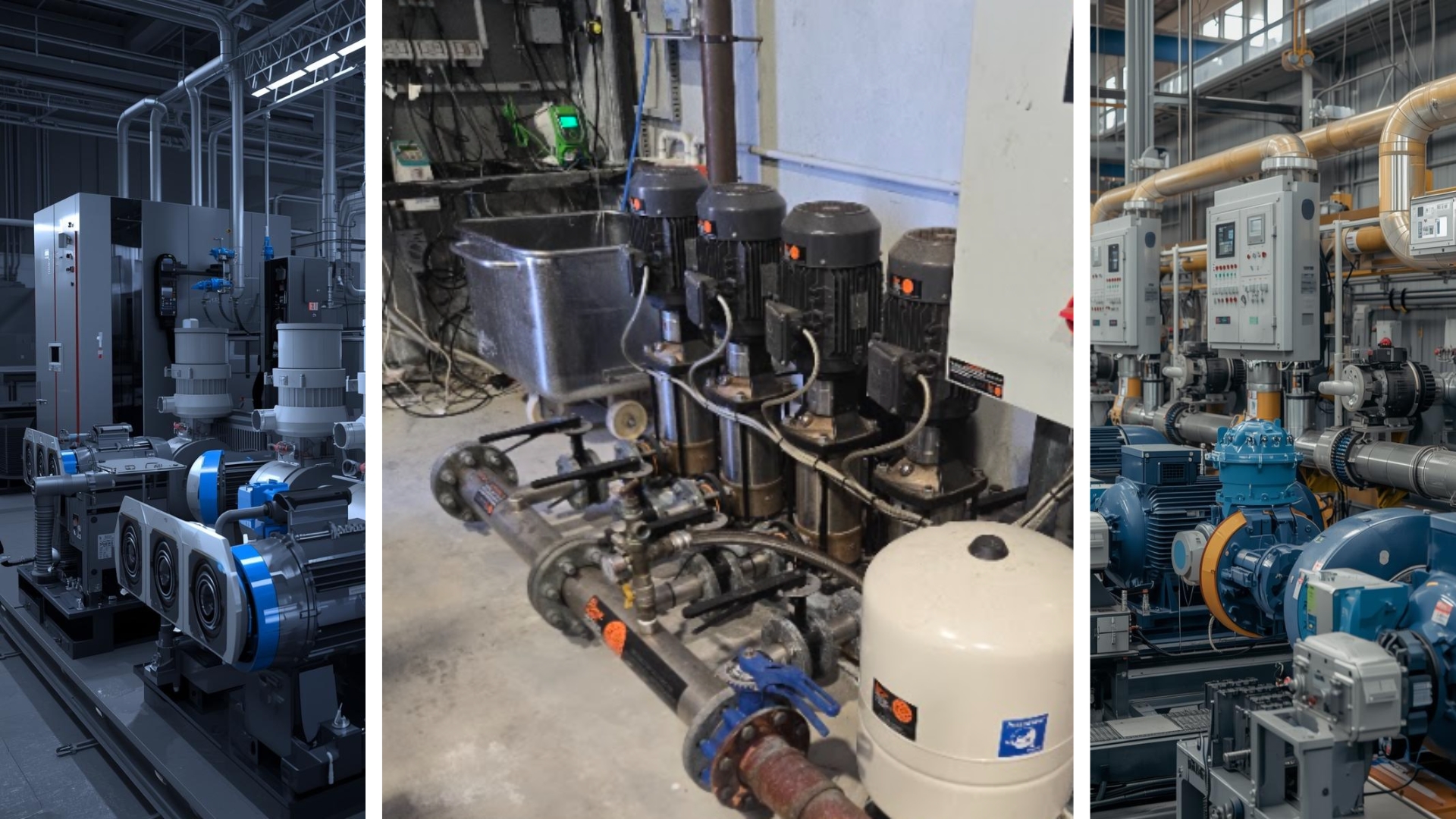
Pumps, Motors, VSDs & Controls
The Control Layer That Determines Whole-Plant Energy Performance
In most industrial facilities, pumps, fans, compressors and motors are the dominant energy users on site — often consuming 50–80% of total electrical energy.
Yet they are usually treated as:
Fixed process loads
Outside the scope of energy projects
Someone else’s responsibility
This is why most energy upgrades underperform.
If pumps, motors and controls are not engineered and optimised correctly, every other energy investment suffers — solar, batteries, heat pumps and thermal storage included.
The Reality of Industrial Energy Use
Across food processing, cold storage, manufacturing and heavy industry:
Most motors operate well below full load most of the time
Flow is controlled mechanically (valves, dampers, bypasses)
Fixed-speed motors dominate legacy plants
Control logic is fragmented or purely local
Energy is not wasted because equipment is inefficient.
It is wasted because systems are not coordinated.
Why Motors Matter More Than Nameplate Power
The physics are well understood:
Motor power draw is proportional to speed³
This means:
20% speed reduction ≈ 50% energy reduction
30% speed reduction ≈ 65% energy reduction
No solar array or battery delivers savings this consistently without first fixing motor control.
Variable Speed Drives (VSDs): Where Real Savings Are Won or Lost
VSDs are not simply about slowing motors down.
When engineered correctly, they:
Match flow and pressure to true process demand
Eliminate throttling losses
Reduce peak electrical demand
Extend motor and equipment life
Enable interaction with solar, batteries and thermal systems
When engineered poorly, they:
Create unstable control loops
Fight upstream and downstream processes
Increase fault rates and harmonics
Deliver far less saving than modelled
VSDs only work when the entire system is designed around them.
Pumps, Motors & Process Loads We Optimise
We routinely optimise:
Process pumps (water, glycol, brine, effluent)
Refrigeration compressors and condenser fans
Air handling and ventilation systems
Cooling towers and evaporative coolers
Process blowers and extract fans
Conveyors and material handling systems
Each of these directly affects:
Electrical demand
Thermal balance
Heat recovery potential
Battery dispatch behaviour
Whole-plant stability
Process-Safe Load Shifting (Without Affecting Production)
A well-controlled industrial energy system can shift when energy is consumed without changing what the process delivers.
This is one of the most misunderstood — and most valuable — aspects of modern energy control.
Most industrial processes care about:
Flow delivered over time
Pressure or temperature within a defined band
Storage levels (tanks, buffers, thermal mass)
End-of-batch or end-of-shift outcomes
They do not care whether:
A pump runs at 92% speed now or 78% speed for 20 minutes
A circulation loop ramps earlier or later
A buffer tank is filled continuously or opportunistically
This creates control headroom that can be used intelligently.
Practical Examples
Solar-Responsive Pumping
Instead of running pumps on fixed schedules:
Pump speed increases when excess solar is available
Buffer tanks are charged opportunistically
Downstream demand is met as normal
The process sees the same result.
The energy system sees a different outcome.
Peak Demand Throttling
During short peak-demand windows:
Non-critical pumps slow slightly
Fans and compressors modulate within safe limits
Thermal or hydraulic buffers absorb the difference
Production continues uninterrupted.
Demand charges are avoided.
Refrigeration & Thermal Coordination
Refrigeration systems pre-cool when energy is abundant
Thermal mass is used as storage
Heat recovery aligns with process heat demand
The system works ahead of the process — not against it.
Why This Does Not Disrupt Industrial Processes
This approach works because:
Control bands are engineered, not guessed
Process constraints are explicitly respected
No system is starved of required flow or pressure
Redundancy and safety margins remain intact
We never “turn things off”.
We modulate intelligently within safe operating envelopes.
Controls: Where Most Sites Actually Fail
Most industrial sites suffer from control fragmentation:
Each vendor supplies their own controller
Systems operate on local logic only
No site-wide optimisation layer exists
Energy flows are never arbitrated
The result:
Pumps ramp while batteries discharge
Heat pumps reject heat while refrigeration dumps it
Solar exports while processes draw grid power
Demand peaks are created, not avoided
This is not an equipment problem.
It is a control and orchestration problem.
Our Approach: Integrated Control & Orchestration
We treat pumps, motors and drives as active participants in the energy system, not passive loads.
Our control philosophy includes:
Site-wide energy orchestration
PLC / SCADA integration
Motor speed linked to energy availability
Demand-aware pump and fan control
Coordination with batteries and thermal storage
Priority logic for critical processes
Continuous optimisation, not static setpoints
Everything responds to system value, not isolated signals.
Why This Is Central to Our Energy-as-a-Service Model
Most EaaS and PPA models exclude motors and process loads because:
They are complex
They require deep process understanding
They blur the line between energy and operations
We include them because that is where performance is actually determined.
If we do not control the loads:
We cannot optimise the system
We cannot guarantee outcomes
We cannot take performance risk
What We Take Responsibility For
Under our optimisation and EaaS engagements, we take responsibility for:
Motor selection and efficiency
VSD sizing and control strategy
Pump and fan curve matching
Control logic and sequencing
Interaction with thermal and electrical systems
Ongoing optimisation and tuning
This is not a one-off upgrade.
It is continuous system operation.
The Bottom Line
If pumps, motors and controls are treated as background equipment, energy projects will always underperform.
When they are treated as part of the energy system:
Savings compound
Stability improves
Capital requirements shrink
Decarbonisation becomes achievable
This is how industrial energy systems are meant to be operated.