Why Integrated Electrification is the Only Viable Industrial Decarbonization Roadmap for Australian Manufacturing
The Real Reason Your Current Decarbonization Roadmap is Stalling
We thoroughly tested industrial decarbonization roadmap manufacturing to help you make an informed decision. Most industrial decarbonization roadmap strategies share a common flaw: they treat energy reduction as a series of independent projects rather than a coordinated system shift. LED lighting upgrades, compressed air audits, and variable speed drives all deliver value, but they don't move the needle on the energy costs that actually define your operating margin.
The core problem isn't a lack of efficiency projects — it's that most roadmaps stop short of fuel switching.
For Australian manufacturers, this matters more than it does in most other markets. Domestic gas prices have increased significantly over the past decade, and that volatility isn't going away. Facilities running gas-fired boilers, ovens, or dryers for low-to-medium temperature Process Heat — typically in the 60°C to 250°C range — are carrying structural cost exposure that incremental efficiency gains won't resolve.
Industrial processes account for approximately 44% of Australia's total energy consumption, according to the DCCEEW, and the bulk of that demand is thermal. Yet most roadmaps treat thermal loads as a separate, harder-to-solve problem — addressed later, if at all.
The approach that consistently delivers better commercial outcomes is designing energy upgrades as one integrated system: Commercial Solar generating low-cost electricity, a Battery Energy Storage System (BESS) managing peak demand and grid tariffs, an Industrial Heat Pump converting that electricity into Process Heat, and Thermal Storage time-shifting that heat to when it's needed most. Integrated industrial energy systems built on this logic address both cost and resilience simultaneously, rather than solving for each in isolation.
The following sections break down the four pillars that make this system-level approach work in practice.
The Four Pillars of a Modern Industrial Decarbonization Roadmap Manufacturing
A structured decarbonization roadmap works because it sequences four interdependent pillars — and skipping any one of them creates gaps that cost more to fix later.
The previous section outlined why piecemeal approaches stall. The alternative is a framework that treats industrial electrification manufacturing decarbonization as a connected system rather than a checklist. The U.S. Department of Energy's Industrial Decarbonization Roadmap identifies a similar four-pillar logic — and Australian manufacturers face comparable structural challenges.
Pillar 1 — Deep Energy Efficiency goes well beyond lighting upgrades or HVAC improvements. The focus here is Process Heat: reducing the total thermal load before investing in electrification equipment. Lower demand means smaller, cheaper systems and a shorter Payback Period.
Pillar 2 — Industrial Electrification means replacing gas boilers and combustion equipment with Industrial Heat Pumps and electric process systems. According to Beyond Zero Emissions, over 50% of Australian industrial gas use is for low-to-medium temperature Process Heat under 150°C — a range that existing heat pump technology can address today.
Pillar 3 — Low-Carbon Energy Sources integrates Commercial Solar and Battery Energy Storage Systems (BESS) to reduce grid dependence and cut the cost of the electricity powering that new electric equipment. Without this pillar, electrification simply shifts the fuel bill.
Pillar 4 — System Integration ties everything together through Thermal Storage, which time-shifts demand away from peak tariff periods and smooths the load profile across the facility. This is where Demand Reduction becomes a financial strategy, not just an operational goal.
Understanding why Heat Electrification sits at the center of this framework — and why it typically delivers the strongest ROI — is where the business case gets compelling.
Why Electrifying Industrial Heat is the Highest ROI Move
For manufacturers serious about manufacturing energy efficiency and decarbonization, process heat is where the business case gets real. Heat accounts for more than 70% of energy consumption in most industrial facilities — and gas-fired systems are delivering that heat in the least efficient way possible.
The Coefficient of Performance (COP) advantage is the key differentiator. A gas boiler converts energy at roughly 85–90% efficiency at best. An Industrial Heat Pump delivering the same process heat operates with a Coefficient of Performance (COP) of 3.0 to 5.0 — meaning it produces three to five units of heat for every unit of electricity consumed. That's not a marginal improvement; it's a structural shift in how efficiently your facility uses energy. According to the Australian Alliance for Energy Productivity, electrifying industrial heat with high-temperature heat pumps can achieve energy savings of up to 60–80% compared to traditional gas boilers.
The cost-of-ownership picture shifts further when you factor in gas infrastructure. Removing gas equipment reduces ongoing compliance costs, eliminates annual pressure vessel inspections, and cuts the safety liability associated with combustion systems. In practice, facilities that have decommissioned gas plant report meaningful reductions in both maintenance spend and insurance exposure.
The "electrification is too expensive" argument typically focuses on capital cost while ignoring Operational Savings and Payback Period. When modeled correctly — accounting for avoided gas costs, reduced maintenance, and demand tariff management — the business case for Heat Electrification frequently delivers paybacks under five years. For manufacturers unwilling or unable to commit capital upfront, Energy-as-a-Service (EaaS) structures remove that barrier entirely.
Capturing the full value of Heat Electrification, however, depends on how well it's paired with storage — which is where the next pillar of an integrated roadmap comes into focus.
The Role of Thermal Storage in Maximizing Solar Self-Consumption
Thermal storage is the missing piece that turns intermittent renewable generation into a reliable, cost-controlled energy supply for Australian manufacturers.
Think of Thermal Storage as a battery for heat — but one that costs significantly less per kilowatt-hour stored than an electrochemical Battery Energy Storage System (BESS). Instead of storing electricity, it stores energy as hot or chilled water, ice, or phase-change material, ready to be dispatched when the process demands it. As IRENA notes, the integration of thermal energy storage with renewable energy generation allows industrial sites to 'time-shift' energy use, significantly reducing peak demand charges.
"The integration of thermal energy storage with renewable energy generation allows industrial sites to 'time-shift' energy use, significantly reducing peak demand charges."— IRENA
Time-shifting is where the business case gets concrete. A site running Commercial Solar can charge a thermal store during peak generation hours — typically mid-morning to early afternoon — then draw on that stored heat through the evening production shift, avoiding costly network peak tariffs entirely. The result is a material reduction in your demand charge exposure without curtailing production schedules.
There's a secondary commercial benefit that's often overlooked: Thermal Storage allows for a smaller, more efficiently sized Industrial Heat Pump. Rather than sizing the heat pump to meet instantaneous peak process heat demand, engineers can size it to average load, with the thermal store bridging the gap during demand spikes. That means lower capital cost, better equipment utilization, and a shorter Payback Period — all of which strengthen the overall business case before you've considered funding structure. That funding question, however, is one many manufacturers find harder to solve than the engineering itself.
Overcoming the CAPEX Barrier with Energy-as-a-Service (EaaS)
The biggest obstacle to integrated electrification isn't technical — it's financial. Industrial heat pumps, Thermal Storage systems, and Battery Energy Storage Systems represent significant upfront capital, and most manufacturing facilities can't absorb that expenditure within a single budget cycle. That delay has a real cost: every year spent waiting is another year of avoidable energy spend.
Energy-as-a-Service (EaaS) removes the capital barrier entirely by converting complex infrastructure projects into a predictable operational expense.
Traditional CAPEX procurement puts the full financial burden on the facility — equipment purchase, installation, commissioning, and ongoing maintenance all sit on the balance sheet. EaaS flips that model. According to Geckon Industry Insights, facilities can implement integrated systems including BESS and Industrial Heat Pumps with zero upfront capital, paying only for the energy delivered. The provider owns, operates, and maintains the assets.
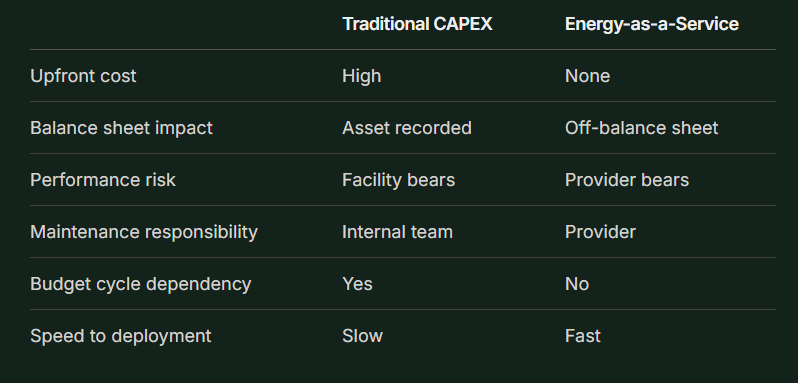
This matters for integrated decarbonization roadmaps because system performance depends on all components — heat electrification, Thermal Storage, and power generation — working together reliably. Under EaaS, that reliability is contractually guaranteed by the provider, not assumed by a stretched internal team. The result is faster deployment, lower operational risk, and Operational Savings that begin immediately rather than after a multi-year approval process.
Understanding how EaaS fits alongside your existing procurement approach is one of the practical decisions every facility lead needs to work through — and it's worth examining alongside the broader strategic considerations before committing to a direction.
What You Need to Know: Key Takeaways for Facility Leads
Integrated electrification works when heat, power, and storage are planned as a single system — not as separate procurement decisions made years apart.
The sections above have walked through the mechanics: why Heat Electrification drives the largest emissions reductions, how Commercial Solar and Thermal Storage combine to shift consumption away from peak tariffs, and how Energy-as-a-Service (EaaS) removes the capital barrier that stops most projects before they start. Here's what facility leads and operations managers should carry forward from that analysis:
The four essentials of a viable industrial electrification roadmap:
Heat is the primary target. Process Heat and space heating account for the majority of industrial energy consumption in Australian manufacturing. Electrification of heat — not lighting or motor upgrades — is where the largest Operational Savings are realized.
Integration isn't optional. An Industrial Heat Pump without Thermal Storage, or Commercial Solar without a Battery Energy Storage System (BESS), delivers a fraction of the potential value. System integration across Heat, Power, and Storage is what produces reliable, cost-controlled outcomes.
Sub-150°C processes are ready now. Food and beverage, dairy, chemicals, and light manufacturing already operate within the temperature range where proven electrification technology is commercially viable. Waiting for technology maturity at this temperature band is not a sound business case.
EaaS solves the capital constraint. Energy-as-a-Service (EaaS) models replace large upfront expenditure with structured service agreements, letting facilities access integrated systems without straining balance sheets or competing for internal capital.
The business case for each of these points is well-supported. The U.S. Department of Energy's Industrial Decarbonization Roadmap identifies electrification and energy efficiency as the two highest-priority near-term levers for industrial sites — a conclusion that applies equally to Australian manufacturing given similar process profiles and grid dynamics.
Knowing the roadmap essentials is the starting point. Translating them into a site-specific plan — with accurate heat-demand profiling, technology selection, and procurement structure — is where the work begins.
Moving from Roadmap to Reality: Your Next Steps
The most important step in any Process Heat Electrification program isn't selecting technology — it's understanding your site's energy profile before committing to a solution.
Start with a site-wide energy audit. A credible assessment maps your current heat demand by temperature, volume, timing, and fuel type. Without this foundation, it's impossible to size an Industrial Heat Pump correctly, determine whether Thermal Storage can shift load cost-effectively, or build a Business Case that holds up under financial scrutiny. Skipping this step is how businesses end up with undersized systems, missed savings targets, and extended Payback Periods.
Look for integrated solution partners, not component vendors. Individual vendors — solar installers, heat pump suppliers, battery distributors — will each optimize for their own product. What Australian manufacturing sites actually need is a partner who designs Commercial Solar, Battery Energy Storage Systems (BESS), Industrial Heat Pumps, and controls as a single coordinated system. The Operational Savings come from how these components interact, not from any one piece in isolation.
Geckon specializes in exactly this: end-to-end EPC delivery and Energy-as-a-Service (EaaS) for complex industrial electrification projects, from initial feasibility through to ongoing Energy Optimisation. Before requesting a proposal, assess your site's heat demand and load profile first — that's where the opportunity is defined. Explore Geckon's industrial energy solutions to understand what a structured feasibility assessment involves.

