How to Measure and Optimize Industrial Building Performance in 5 Steps
Step 1: Conduct a Comprehensive Building Performance Audit
Reducing energy costs in an industrial facility starts with an accurate picture of where energy is consumed, wasted, and constrained. Without that baseline, any investment in commercial solar, Battery Energy Storage System (BESS), or Industrial Heat Pump is based on assumption rather than evidence.
A thorough audit captures the building performance indicators that determine whether efficiency improvements will deliver meaningful operational savings — or simply shift the problem. Collect the following data points before drawing any conclusions:
Energy inputs: Quantify gas, grid electricity, and onsite renewable generation separately, including time-of-use profiles
process heat requirements: Map temperature levels and volumes for each thermal process — low-grade heat (below 80°C) and high-grade heat (above 150°C) have fundamentally different technology options
Building performance standards compliance: Assess gaps against applicable regulatory benchmarks and any mandatory reporting obligations
Sub-metering data: Isolate poorly performing subsystems — HVAC, compressed air, refrigeration, and lighting frequently account for disproportionate consumption
Baseline matters: Traditional gas-powered boilers typically operate at only 80–95% efficiency, meaning a facility running unmonitored gas heating may be losing up to 20 cents in every dollar spent on fuel.
With this data collected, the next step is to benchmark your site against established industrial performance metrics — including energy use intensity and coefficient of performance — to identify exactly where the largest efficiency gains are available.
Step 2: Benchmark Against Building Energy Performance Metrics
With audit data in hand, the next step is translating raw consumption figures into meaningful building energy performance metrics that reveal where your site stands relative to industry standards — and where the largest savings opportunities lie.
Follow this process to benchmark effectively:
Calculate energy use intensity (EUI) by dividing total annual energy consumption (MJ or kWh) by gross floor area. For industrial facilities, calculate EUI separately for process loads and building services — blending the two masks where energy is actually lost.
Assess coefficient of performance (COP)for every heating and cooling system on site. A COP below 2.5 on existing equipment signals a strong business case for replacement or supplementation with an integrated industrial energy system.
Compare against Australian industrial benchmarks using the table below as a reference. Sites performing above these thresholds typically carry avoidable energy costs.
Identify renewable generation dumping by reviewing interval meter data during peak solar hours. Curtailed or exported solar that could otherwise offset grid demand represents direct operational savings foregone — and quantifying it strengthens the Business Case for Battery Energy Storage System (BESS) investment.
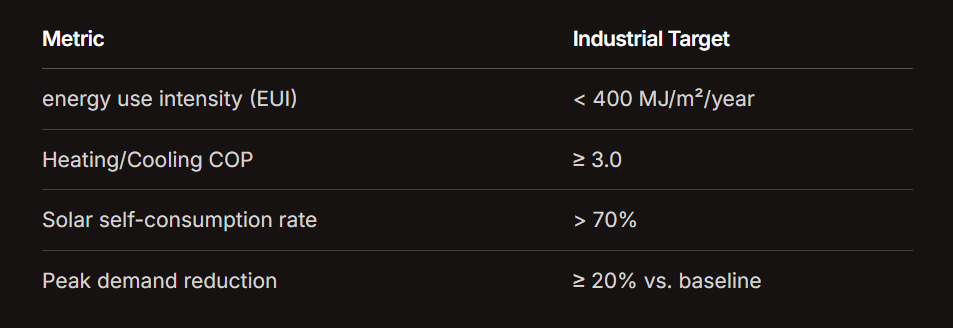
In practice, food and beverage sites often show the widest gap between actual and target COP — research from IEEFA Australia indicates Industrial Heat Pump could deliver energy savings of 80–90% in centralized thermal systems in that sector. Benchmarking makes that gap visible and defensible.
Once you've established where heating efficiency is falling short, the logical next step is addressing process heat directly — which is where electrification delivers the most significant payback period improvements.
Step 3: Electrify process heat with Industrial Heat Pump
Your building performance audit has identified where energy is lost — now it's time to address one of the highest-impact opportunities in most industrial facilities: gas-fired process heat. Replacing combustion-based systems with Industrial Heat Pump delivers measurable operational savings while reducing exposure to volatile gas prices.
The electrification case is straightforward. According to IEEFA, industrial heat pumps achieve 300–500% efficiency — meaning a coefficient of performance (COP) of 3.0 to 5.0 — outperforming gas boilers by a factor of four or more. That efficiency gap directly translates to lower energy spend per unit of process heat delivered.
Follow this sequence to implement Heat Electrification effectively:
Select heat pumps by output temperature. Match equipment to your process requirements — hot water applications suit standard units, while high-temperature steam demands purpose-built high-lift configurations.
Audit your existing thermal distribution network. Identify pipe sizing, pressure ratings, and heat exchanger compatibility before specifying equipment to avoid costly retrofits.
Target a COP between 3.0 and 5.0as your minimum performance threshold during equipment selection — anything below this range weakens the Business Case against gas.
Integrate heat pumps with existing distribution infrastructure to minimize capital expenditure and preserve operational continuity during commissioning.
Eliminate gas combustion at the point of heat generation to reduce site-wide carbon intensity and remove exposure to gas network tariffs.
In practice, facilities that design integrated energy systems from the outset achieve faster payback periods than those retrofitting components in isolation. However, integration complexity is a real consideration — thermal storage can further improve utilization of installed heat pump capacity, which the next step addresses directly.
Step 4: Integrate thermal storage as an Energy Shock Absorber
Having electrified your process heat load, the next challenge is managing when that energy is consumed. Australian wholesale electricity markets are volatile — and knowing how to measure building performance over time means understanding that energy unit costs matter as much as total consumption.
Thermal Energy Storage (TES)decouples heat generation from heat consumption, giving you direct control over your energy cost exposure. The commercial case is clear: according to a University of Adelaide study, TES is up to four times more cost-effective than electrical battery storage for high-temperature heat applications. For heat-intensive industrial sites, this is a significant Business Case differentiator.
Here's how to implement a charge/discharge strategy that stabilizes operational savings:
Map your price exposure. Identify hours when spot prices turn negative or drop below your average tariff. In 2023, negative pricing occurred in approximately 20% of market hours across key Australian regions — these windows are your lowest-cost charging opportunities.
Charge storage during low-cost windows. Run your Industrial Heat Pump or heating system during negative or off-peak pricing periods, storing thermal output in insulated buffer tanks or phase-change media rather than drawing heat in real time.
Discharge during peak demand periods. Release stored heat during high-tariff or high-demand windows, reducing both energy spend and Demand Reduction exposure on your network tariff.
This approach transforms energy price volatility from a cost risk into a procurement advantage. However, TES is most effective when integrated with building controls and metering — a consideration that directly shapes the performance outcomes covered in the final step.
How to Maintain High Performance: The Bottom Line
Sustainable industrial energy optimization isn't a one-time project — it's the result of integrated systems working together continuously. Here's how to consolidate the approach covered in this guide into lasting operational performance:
Integrate all systems under a single controls layer. Integrated systems consistently outperform disparate components. Solar, Battery Energy Storage System (BESS), Industrial Heat Pump and thermal storage deliver their full value only when coordinated through intelligent energy management — not operated in isolation.
Prioritize thermal storage over electrical batteries for heat-intensive sites. For facilities with significant process heat demand, thermal storage delivers superior ROI. Research indicates integrated thermal storage can generate investment returns exceeding 150% by capturing negative electricity pricing events — an outcome electrical batteries rarely match at equivalent capital cost.
Treat Heat Electrification as a gas cost hedge. Electrification removes direct exposure to rising gas prices. As network costs and commodity pricing continue upward, locking process heat into electricity — ideally self-generated — reduces long-term cost volatility.
Remove the CAPEX barrier with energy-as-a-service. energy-as-a-service (EaaS) allows businesses to access high-performance infrastructure without upfront capital expenditure. operational savings fund the project, making the Business Case accessible regardless of budget cycle constraints.
Review performance continuously, not annually. High-performance facilities treat energy data as an operational input. Regular benchmarking, demand analysis and system tuning protect payback period assumptions and extend asset life.
Apply these five steps consistently and the result is a facility that reduces cost, manages demand and builds long-term resilience.
Key Takeaways:
Integrated systems outperform disconnected components across every performance metric
thermal storage offers higher returns than electrical batteries for heat-intensive operations
Heat Electrification is the most effective long-term hedge against gas price escalation
energy-as-a-service (EaaS) eliminates upfront capital as a barrier to Energy Reduction
Continuous monitoring protects projected operational savings and payback period outcomes
Ready to assess your facility's potential? Evaluate your energy reduction opportunity with Geckon to build a commercially grounded business case for your site.

