Why Industrial Fruit Drying Efficiency is the Next Frontier for Australian Food Processors
The Hidden Energy Cost of Industrial Fruit Drying
Industrial fruit drying is one of the most energy-intensive stages in food manufacturing — and for most Australian processors, it's also one of the least optimized.
Drying consistently ranks among the top energy cost centers in food processing operations, and the numbers behind this are difficult to ignore. Industrial drying processes account for approximately 10% to 25% of total industrial energy consumption in developed nations, according to the International Energy Agency. In Australia, the exposure is amplified further: food processing, including fruit and vegetable drying, accounts for roughly 28% of all industrial gas use, as reported by the Australian Alliance for Energy Productivity.
That dependence on gas is now a structural risk. Wholesale gas prices in Australia have been volatile for several years, and tightening carbon regulations are adding a cost layer that didn't exist a decade ago. Processors who built their business models around cheap, stable gas are finding those assumptions no longer hold.
The bigger waste, however, is hiding in the exhaust stack. Traditional drying systems vent hot, moisture-laden air directly to atmosphere — discarding the latent thermal energy embedded in that air rather than recovering it. This isn't a marginal inefficiency. It's a design flaw that compounds across every operating hour.
Business as usual is no longer a viable position. The combination of energy price exposure, regulatory pressure and built-in thermal waste means the next competitive advantage in Australian food processing lies in how processors fundamentally rethink their drying technology — and that conversation starts with understanding why heat pump technology changes the economics entirely.
Why Heat Pump Technology is the Best Way to Dry Fruit at Scale
Heat pump drying represents a fundamental shift in how industrial fruit processors should think about thermal energy — moving from combustion-based waste to closed-loop precision.
Traditional gas combustion and resistive electric heating treat thermal energy as a consumable. You generate heat, push it through a drying chamber, and exhaust the moisture-laden air — along with most of the energy you paid for. Every kilogram of water removed carries with it a significant thermal penalty. At industrial scale, those penalties compound fast.
Heat pump drying works differently. Rather than generating heat through combustion or resistance, it extracts latent thermal energy from exhaust air and recycles it back into the drying cycle. This closed-loop heat recovery mechanism is what delivers the efficiency gains — and according to research published in the Journal of Cleaner Production, heat pump drying technology can reduce energy consumption by up to 60–80% compared to conventional hot air-drying methods. That's not a marginal improvement; it's a structural cost reduction.
Process heat electrification via heat pumps also gives operators something gas burners can't: precise, programmable temperature control across the full drying curve. Fruit quality is highly sensitive to temperature excursions — too high and you damage color, texture, and nutritional value; too low and drying times blow out. Heat pumps maintain tighter tolerances, which means more consistent product yield and less downgrade waste.
The broader shift here is conceptual. Effective industrial drying isn't about heating air — it's about managing thermal energy across an entire system. Once processors understand that distinction, the business case for electrification becomes considerably easier to evaluate — which is exactly what the next section examines.
The Economic Case for Electrifying Thermal process heat
Electrifying fruit drying process heat isn't a sustainability gesture — it's one of the strongest capital investments an Australian food processor can make right now.
Australian commercial electricity rates and the economics of heat pump drying technology combine to deliver payback periods that typically range from three to seven years, depending on site scale, gas displacement volume, and grid tariff structure. The critical driver is the Coefficient of Performance (COP). According to the Australian Renewable Energy Agency (ARENA), high-temperature heat pumps achieve COPs between 2.0 and 5.0 in industrial drying applications. In practice, that means for every dollar of electricity consumed, you're generating two to five dollars' worth of usable thermal energy — a margin that combustion systems simply can't match.
Reduced maintenance overhead is another financial benefit that often gets underestimated in early-stage business cases. Combustion-based drying systems carry ongoing costs: burner servicing, flue inspections, gas safety compliance, and heat exchanger replacements. Moving to electrified heat eliminates most of that overhead, reducing both planned maintenance spend and unplanned downtime risk.
And there's a forward-looking financial argument worth including in any business case: electrification hedges against future carbon pricing. Australia's regulatory environment is tightening. Gas-intensive operations face rising exposure to carbon liability. Locking in electric process heat now removes that variable from your cost forecast entirely.
The operational savings stack up across multiple categories — energy unit costs, maintenance, compliance risk, and carbon exposure. Before the numbers fully crystallize, though, how you integrate heat pump drying into your broader site energy system determines whether you capture all of them or only some.
Integrating Drying into a Site-Wide Energy System
A heat pump dryer running in isolation will rarely deliver its full potential —industrial energy optimization only happens when the dryer is treated as one component in a coordinated site-wide energy system.
The dryer is an energy load, and like any significant load, it should be scheduled, buffered, and controlled. According to the Australian Renewable Energy Agency (ARENA), heat pumps already deliver 2 to 5 units of thermal energy per unit of electricity consumed. But that efficiency gain compounds further when the electricity feeding the system comes from on-site solar PV at near-zero marginal cost, or from a Battery Energy Storage System (BESS) charged during off-peak tariff windows.
Thermal Storage is the often-overlooked piece of this puzzle. By pre-heating a thermal buffer during solar-heavy midday hours, processors can shift the active drying load away from peak grid pricing periods without interrupting production continuity. That load shifting directly reduces demand charges — frequently one of the largest line items on a commercial energy bill.
What typically happens with 'plug-and-play' dryer installations is that the equipment performs well in isolation but fails to account for the site's broader tariff structure, solar generation profile, or grid connection limits. The result is underwhelming savings relative to the original business case.
The integration components that drive real operational savings include:
Commercial Solar— supplies low-cost daytime electricity to run the heat pump at minimal variable cost
Battery Energy Storage System (BESS)— stores excess solar or off-peak grid power to extend low-cost operation into evening drying cycles
Industrial Heat Pump— converts electrical input into process heat at high efficiency, with output timed to match available low-cost energy
Advanced Controls— optimize the drying curve in real time, matching temperature and airflow profiles to product moisture content while responding to energy price signals
Advanced controls deserve particular emphasis. Drying is not a static process — moisture load, ambient conditions, and product density all shift throughout a batch. Without intelligent controls coordinating the heat pump, thermal storage, and drying schedule, the system defaults to conservative, energy-wasteful settings.
For processors evaluating capital deployment, the question isn't simply whether a heat pump dryer pays back — it's whether the broader system is designed to maximize that return. And that question about capital deployment leads directly to how the investment gets structured in the first place.
Overcoming the CAPEX Barrier: energy-as-a-service
The biggest obstacle to upgrading Australian food manufacturing energy systems isn't technology — it's capital allocation. High-efficiency industrial heat pump dryers deliver compelling payback periods, but securing approval for six- or seven-figure capital expenditure competes with production upgrades, compliance requirements, and working capital demands. That tension is real, and it stalls otherwise sound projects.
energy-as-a-service (EaaS) removes the upfront cost entirely — facilities access upgraded equipment and operational savings from day one, funded through the savings the system generates.
The contrast with traditional CAPEX is straightforward:
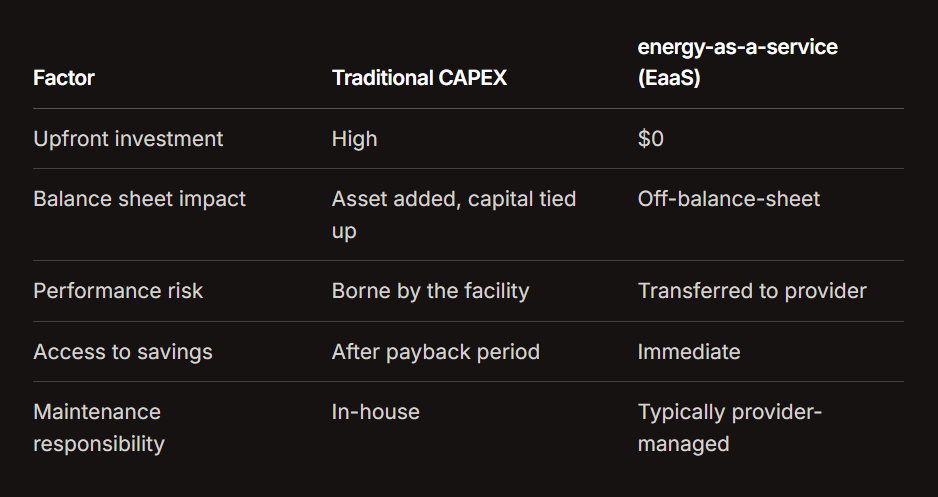
Under an EaaS model, the technology provider funds, installs, and maintains the system. The facility pays a contracted service fee — structured so that total outgoings remain below current energy spend. And because performance risk transfers to the provider, there's a direct commercial incentive to ensure the system delivers. This is why EaaS is gaining traction across Australian manufacturing: it converts a capital decision into an operational one, clearing the approval path considerably.
The efficiency gains discussed in earlier sections — demand reduction, solar integration, thermal storage — become accessible without waiting for a capital budget cycle. For facility leaders assessing where to act first, the financial model is often the deciding factor. The next section consolidates the key conclusions to help frame that decision.
The Bottom Line: Key Takeaways for Facility Leaders
Decarbonizing thermal processes in food manufacturing isn't a future ambition — it's a commercially urgent priority, and industrial fruit drying sits squarely in the crosshairs.
The evidence across this article points to four conclusions that facility leaders and operations managers should carry forward:
Drying is your highest-leverage thermal target. Energy-intensive drying operations typically represent the largest single source of gas consumption on a food processing site. That makes them the primary candidate for energy reduction — not a secondary consideration.
Heat pump technology delivers real, measurable savings. Switching from gas-fired drying to an Industrial Heat Pump system can reduce thermal energy consumption by up to 80%, with payback periods that are increasingly viable as gas prices continue to rise across Australian markets.
System-level integration multiplies the return. A heat pump operating alongside Commercial Solar and a Battery Energy Storage System (BESS) creates a site-wide hedge against energy price volatility. The operational savings compound when generation, storage and process heat work together rather than in isolation.
Capital doesn't have to be the barrier. Energy-as-a-service (EaaS) models allow facilities to fund the transition from operational budgets, turning an infrastructure upgrade into a predictable cost-per-unit-of-energy arrangement.
The business case for upgrading industrial drying is built on savings, not sentiment. And with the Australian Safeguard Mechanism tightening emissions baselines, the cost of maintaining gas-fired thermal loads is only heading in one direction. Knowing where to start — and how to structure the transition — is what separates facilities that capture these savings from those that defer them indefinitely.
Navigating the Transition to Modern Drying Systems
The most effective path to industrial fruit drying efficiency starts with understanding your current energy baseline — not selecting technology. Businesses that begin with a site-wide energy audit consistently identify more savings opportunities than those that jump straight to equipment replacement. A structured feasibility study maps your actual gas consumption, drying throughput, and load profiles, and it surfaces the quick wins — poorly controlled exhaust dampers, oversized burners running at part-load, or uninsulated ductwork — before any capital is committed.
Evaluating gas usage in the drying process specifically matters because heat is typically the dominant cost in fruit processing operations. Identifying where energy is wasted, recovered, or unnecessarily consumed gives you the data needed to build a credible business case for an upgrade. And it shapes which combination of technologies — Industrial Heat Pumps, Thermal Storage, or Commercial Solar — actually makes sense for your facility's load profile and operating schedule.
The role of an experienced EPC partner becomes critical at this stage. Geckon specializes in EPC and energy-as-a-service (EaaS) models that treat heat, power, and storage as a single engineered system — not separate procurement decisions. That integrated approach is what separates a genuinely optimized drying system from one that simply swaps one component for another.
Moving from a component-based mindset to an 'Engineered as One' approach is where the real operational savings are unlocked. The Payback Period shortens when heat recovery, process scheduling, and renewable generation are designed together from the outset.
Ready to assess your facility's drying efficiency potential? Start with a structured energy and feasibility review. Contact Geckon to evaluate your current gas usage, identify energy reduction opportunities, and determine whether EaaS is the right delivery model for your operation.

