How to Size a Commercial Expansion Tank for Industrial Hydronic Systems
Step 1: Calculate Total System Water Volume
Step 2: Determine the Fluid Expansion Factor
With your total system water volume confirmed, the next step in accurate expansion tank sizing is calculating how much that fluid will expand across its operating temperature range. This figure drives the tank's minimum required capacity.
Follow this sequence to calculate your fluid expansion factor:
Identify your minimum and maximum operating temperatures. Record the system's cold-fill temperature (typically 10°C) and its peak operating temperature. The difference — the temperature delta — determines how aggressively the fluid expands.
Select the correct expansion coefficient for your fluid type. Pure water and glycol blends behave differently under heat. Use the table below as a reference and consult the Westank expansion tank sizing guide for glycol-specific coefficients at higher concentrations.
Apply the rule-of-thumb baseline check. For standard heating applications, ASHRAE guidance suggests sizing the expansion tank to approximately 2%–3% of total system volume. Use this as a sanity check against your calculated result.
Calculate total expanded volume. Multiply your confirmed system volume (from Step 1) by the appropriate expansion factor: Expanded Volume = Total System Volume × Expansion Factor.
Expansion factors for water at common operating temperatures:
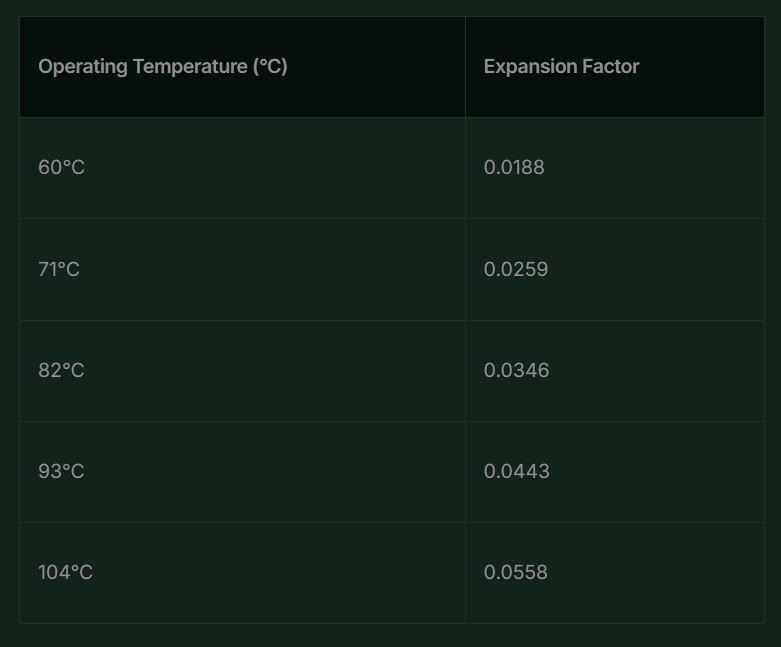
In practice, industrial hydronic systems running Process Heat applications at higher temperatures carry significantly larger expansion volumes — making precise calculation critical, not optional.
With the expanded volume confirmed, the next step is determining how much of that volume the tank can actually accept under working pressure conditions.
Accurate commercial expansion tank sizing starts with a precise inventory of every fluid-containing component in the hydronic circuit. Underestimating system volume is one of the most common causes of tank undersizing — and the consequences range from pressure relief valve cycling to system damage.
Work through the audit in this order:
Inventory all piping runs using isometric drawings or as-built documentation, calculating pipe volume by diameter and length.
Record heat exchanger and chiller volumes from manufacturer data sheets — internal fluid volumes vary significantly between models and are rarely negligible.
Measure terminal unit volumes including fan coil units, air handling coils, and radiant panels, again using manufacturer specifications rather than estimates.
Account for Thermal Storage vessels, which can add thousands of liters to the total circuit volume in Industrial Heat Pump systems — this step is frequently overlooked and causes the largest sizing errors.
Sum all component volumes to produce a single total system fluid volume figure, which feeds directly into every subsequent sizing calculation.
A useful reference point: water expands approximately 4.2% in volume when heated from 4°C to 100°C, so even modest volume underestimates compound into significant expansion errors.
Note for closed-loop vs. potable systems: The fluid type and system classification matter. Closed-loop hydronic circuits and potable water systems use different sizing methodologies — confirm which applies before using any commercial expansion tank sizing calculator.
With total system volume established, the next step is determining how much that fluid will actually expand across your operating temperature range.
Step 2: Determine the Fluid Expansion Factor
With your total system water volume confirmed, the next step in accurate expansion tank sizing is calculating how much that fluid will expand across its operating temperature range. This figure drives the tank's minimum required capacity.
Follow this sequence to calculate your fluid expansion factor:
Identify your minimum and maximum operating temperatures. Record the system's cold-fill temperature (typically 50°F) and its peak operating temperature. The difference — the temperature delta — determines how aggressively the fluid expands.
Select the correct expansion coefficient for your fluid type. Pure water and glycol blends behave differently under heat. Use the table below as a reference and consult the Westank expansion tank sizing guide for glycol-specific coefficients at higher concentrations.
Apply the rule-of-thumb baseline check. For standard heating applications, ASHRAE guidance suggests sizing the expansion tank to approximately 2%–3% of total system volume. Use this as a sanity check against your calculated result.
Calculate total expanded volume. Multiply your confirmed system volume (from Step 1) by the appropriate expansion factor: Expanded Volume = Total System Volume × Expansion Factor.
Expansion factors for water at common operating temperatures:
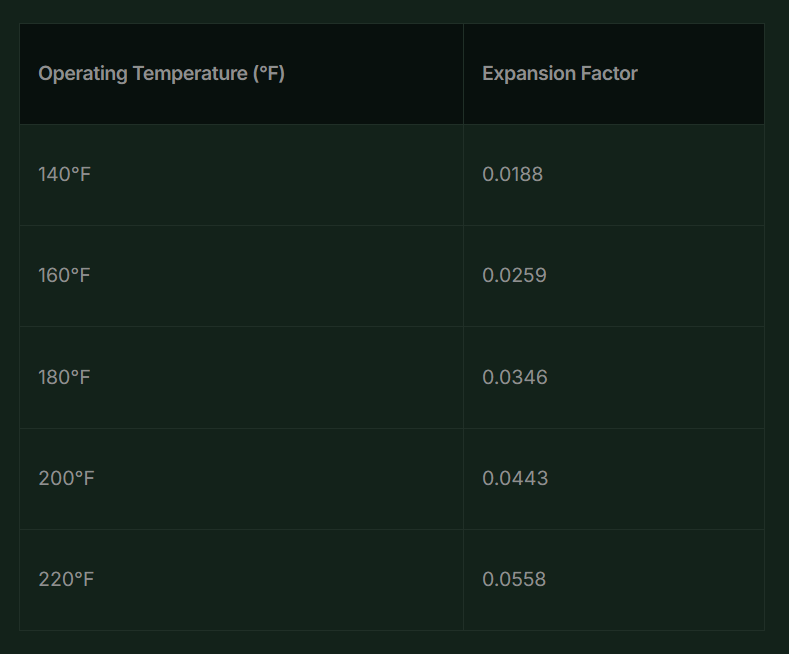
In practice, industrial hydronic systems running Process Heat applications at higher temperatures carry significantly larger expansion volumes — making precise calculation critical, not optional.
With the expanded volume confirmed, the next step is determining how much of that volume the tank can actually accept under working pressure conditions.
Step 3: Calculate Required Acceptance Volume
With your fluid expansion volume confirmed, the next critical step in learning how to size an expansion tank is distinguishing between the tank's total shell volume and its acceptance volume— the actual amount of expanded water the tank can absorb under operating pressure. As AMTROL notes, sizing to total tank volume rather than acceptance volume is a common and costly mistake.
Apply these steps in sequence:
Set the pre-charge pressure. Match the tank's air-side pre-charge to the system's cold static fill pressure — typically the pressure at the tank's connection point with the system cold.
Identify the Maximum Allowable Working Pressure (MAWP).Use the lowest-rated component in the circuit — often the pressure relief valve set point — as your upper pressure limit.
Apply the acceptance volume formula:
Acceptance Volume = Expanded Volume ÷ [(P_max − P_pre) ÷ P_max]
Where P_max is the MAWP and P_pre is the pre-charge pressure, both expressed in absolute pressure (psia).
Select a tank whose acceptance volume meets or exceeds this result.A tank with a larger shell but insufficient acceptance volume will fail under pressure cycling.
⚠ Important: Never specify a tank based on nominal tank volume alone. A 40-gallon tank may carry an acceptance volume well below 20 gallons depending on pressure settings — leaving the system underprotected.
Once you've confirmed the required acceptance volume, the next step is feeding these values into a selection tool to verify tank model compatibility and physical fit.
Step 4: Use Selection Tools and Wizards for Final Verification
With your acceptance volume calculated, manual figures need confirming against verified selection tools before you commit to a tank specification. As IAPMO notes, proper expansion tank sizing is critical for protecting system components from pressure fatigue — a leading cause of premature failure in heat pump heat exchangers.
Follow this verification sequence:
Input your manual data into a dedicated tool such as the Expansion Tank Wizard or the Watts sizing calculator to cross-check your acceptance volume against manufacturer data.
Cross-reference an expansion tank size chart to identify models that meet or exceed both your total system volume and calculated acceptance volume — never select based on nominal tank volume alone.
Verify physical dimensions against your facility's available footprint, including clearance for maintenance access and pressure gauge connections.
Consult an EPC specialist for complex integrated systems — particularly where Thermal Storage, industrial heat pumps, or Battery Energy Storage Systems interact within the same hydronic loop.
On complex sites, oversizing is generally the safer default. A tank that's slightly larger than required carries minimal cost penalty; an undersized tank creates chronic pressure cycling that shortens component life across the entire system. For facilities evaluating comprehensive hydronic upgrades, industrial energy specialists can assess whether Energy-as-a-Service (EaaS) funding removes the capital barrier entirely. With verification complete, the next step is pulling your sizing decisions into a coherent strategy.
How to Summarize Your Sizing Strategy
Accurate expansion tank sizing comes down to a disciplined sequence of decisions, not a single calculation. Follow these steps to consolidate your approach before finalizing any specification or procurement.
Size to acceptance volume, not nominal tank capacity. The acceptance volume is dictated by the pre-charge pressure and the maximum operating pressure of the system, as outlined by AMTROL. A larger nominal tank means nothing if the usable acceptance volume is undersized for your fluid expansion load.
Confirm thermal storage volumes separately. Industrial Thermal Storage systems generate significantly larger fluid expansion volumes than standard hydronic circuits. Size these circuits independently before combining them into a system-level calculation.
Match pre-charge pressure to system static pressure. Verify this figure before installation — a mismatch between pre-charge and static pressure will reduce effective acceptance volume and risk waterlogging the tank under operating conditions.
Validate figures using a dedicated sizing tool. Cross-check manual calculations against a tool such as the Westank tank sizing guide or the Watts potable water expansion tank sizing calculator, which also covers potable water expansion tank sizing requirements for mixed-use facilities.
Evaluate funding options for system upgrades. If this sizing exercise is part of a broader Energy Optimisation project, consider Energy-as-a-Service (EaaS) as an alternative to capital expenditure. EaaS allows businesses to fund comprehensive system upgrades — including Industrial Heat Pumps and controls — against Operational Savings rather than upfront budget.
Apply these steps in sequence and your sizing strategy will be both technically sound and commercially defensible. To assess whether your system upgrade qualifies for an EaaS arrangement, contact Geckon for a feasibility evaluation.

