The Hidden Cost of Fragmented Energy Systems in Australian Industrial Facilities
The Reality of Energy Volatility in Australian Industry
Industrial energy costs in Australia have become one of the most significant threats to manufacturing margins— and for facilities still running gas-fired boilers and disconnected HVAC systems, the risk is compounding every quarter.
Electricity prices have increased by up to 20% annually during recent peak periods for Australian industrial facilities, according to the Australian Energy Regulator's State of the Energy Market Report. But the more damaging trend is the one that doesn't show up clearly on a single invoice: the structural cost of fragmented, inefficient energy systems that treat heating, cooling, and power as separate problems rather than a connected opportunity.
'Business as usual' with gas-fired boilers is no longer a neutral financial position. Rising gas prices, tightening supply contracts, and increasing carbon exposure have turned gas dependency into a high-risk strategy. Facilities carrying significant gas load are now exposed to both commodity price volatility and stranded asset risk — the prospect of infrastructure that becomes uneconomical before the end of its operational life.
The real lever isn't the unit price of energy — it's system efficiency and demand reduction. Shifting focus from what you pay per gigajoule to how effectively your facility converts energy into useful output is where meaningful operational savings are found. And that conversation starts with understanding how your heating and cooling loads interact — which is exactly what the next section addresses.
Why HVAC and process heat are Your Biggest Cost Drivers
HVAC and process heat are where most industrial energy budgets quietly bleed out — and they're also where the strongest business case for change exists.
According to the Australian Department of Climate Change, Energy, the Environment and Water, HVAC and water heating account for approximately 60% of total energy consumption in Australian commercial and industrial buildings. That's the majority of your energy spend concentrated in systems that many facilities manage separately, inconsistently, and often inefficiently.
Traditional combustion — gas boilers, direct-fired heaters — remains the default for low-to-medium grade process heat in Australian industry. But combustion is an inherently wasteful conversion process. A significant portion of the fuel energy is lost as flue gas or radiated heat before it reaches the process. Process heat electrification offers a fundamentally different approach: instead of burning fuel to generate heat, electric systems move heat that already exists in the environment, delivering more usable energy per dollar spent.
The bigger structural problem, though, is the silo effect. In most facilities, heating and cooling systems operate as completely independent assets — designed, procured, and managed without any reference to each other. This creates predictable and costly inefficiencies:
Chillers reject heat to atmosphere while boilers burn gas to generate it elsewhere in the same facility
Refrigeration systems run at peak load during periods when waste heat recovery could offset heating demand
Compressed air and steam systems operate on fixed schedules rather than responding to actual thermal demand
Heat is a resource that can be moved and stored, not just generated. Once you reframe it that way, the operational savings available through integration become substantial. That shift in thinking — from siloed generation to connected thermal management — is exactly what makes industrial heat pumps and electrification such a compelling commercial opportunity, which we'll examine in the next section.
The Case for Industrial Heat Pumps and Electrification
Industrial heat pumps deliver a fundamentally better energy conversion ratio than gas boilers — and that difference has a direct, measurable impact on your operating costs.
The core metric here is the Coefficient of Performance (COP). A gas boiler converts fuel to heat at roughly 80–90% efficiency at best. An industrial heat pump, by contrast, moves heat rather than generating it — drawing thermal energy from ambient air, water, or waste heat sources and amplifying it electrically. A well-specified system typically achieves a COP of 3 to 5, meaning for every unit of electricity consumed, you get three to five units of usable heat. That's not a marginal improvement; it's a structural shift in how your facility converts energy spend into process output.
The energy reduction potential is substantial. According to the Australian Renewable Energy Agency (ARENA), transitioning from gas-fired boilers to industrial heat pumps can reduce energy consumption for water heating and process heat by 60% to 80%. For a facility spending $500,000 annually on gas for heat, that represents $300,000–$400,000 in potential operational savings — the foundation of a credible industrial heat pump ROI calculation.
Gas market exposure is the other half of the equation. As covered in the previous sections, gas pricing in Australia has become increasingly unpredictable. Electrification removes that volatility from your balance sheet entirely. Electricity pricing, particularly when paired with Commercial Solar and a Battery Energy Storage System (BESS), is far more controllable. You can fix a meaningful portion of your energy input cost rather than riding the spot market.
On reliability: modern industrial heat pump systems are engineered for continuous industrial duty cycles. In practice, they're deployed across food processing, dairy, brewing, and chemical manufacturing — environments where unplanned downtime is commercially unacceptable. Units are designed with redundancy in mind, and service intervals are predictable. That said, sizing and integration quality matter significantly; a system matched to your actual load profile will consistently outperform one oversized or undersized at specification stage.
The efficiency gains from heat electrification become even more compelling when you introduce the ability to store that thermal output — shifting when heat is generated relative to when electricity is cheapest.
Thermal Storage: The Bridge to Renewable Integration
Thermal storage is what turns intermittent solar generation into a dependable industrial energy asset — and without it, heat pump systems rarely deliver their full commercial potential.
As Beyond Zero Emissions notes in their Electrifying Industry Report, "thermal energy storage acts as a 'thermal battery,' allowing facilities to shift their heaviest heating and cooling loads to periods of high solar generation or low off-peak tariffs. "That framing matters commercially. You're not just storing heat — you're storing cheap energy in a usable form, then deploying it when grid electricity is most expensive.
Load shifting is where the operational savings become tangible. When thermal storage is sized correctly alongside an Industrial Heat Pump, the system can charge during peak solar hours and discharge during evening production peaks. That directly reduces peak demand charges — often one of the largest line items on an Australian industrial electricity bill. demand reduction of this kind doesn't require behavioral change from operators; it's engineered into the system from the start.
There's a secondary benefit that's frequently overlooked: thermal storage allows for smaller, more cost-effective heat pump sizing. Rather than engineering the heat pump to meet instantaneous peak load, you size it against average demand and let storage cover the peaks. That reduces capital expenditure and shortens the payback period — a meaningful difference when you're building a Business Case for board approval.
For facilities that aren't ready for upfront capital commitment, energy-as-a-service for manufacturing offers a structured alternative — bundling thermal storage, heat pumps and controls into a single performance contract with no capital outlay. But whether the project is owned or financed, the engineering logic is the same: storage has to be designed as part of the system, not bolted on afterward. That distinction becomes critical when you consider how these individual technologies interact — which is exactly what the next section addresses.
Moving from Equipment Upgrades to System Integration
Most industrial facilities that struggle with high energy costs aren't running bad equipment — they're running good equipment that was never designed to work together.
When your Battery Energy Storage System, Commercial Solar array, and Industrial Heat Pump operate under separate control logic, you lose the coordination that makes each asset financially viable.
Component-first thinking is the default in most capital planning cycles: a solar array gets approved in one budget round, a BESS added the next year, and a heat pump considered separately when the gas contract comes up for renewal. Each project clears its own payback hurdle in isolation. But without a single control layer governing how energy flows between them — when to store, when to dispatch, when to shift process heat loads — the system underperforms against every individual projection. The thermal energy storage benefits that look compelling on a spec sheet only materialize when thermal assets are dispatched in response to real-time solar output and grid tariff signals.
Site-level feasibility is where this breaks down in practice. A common pattern is that components are sized to a nameplate specification rather than to the actual load profile, demand peaks, and tariff structure of a specific site. The result is stranded assets: a BESS that can't export fast enough to cut peak demand charges, or a heat pump sized for average load that can't respond during the periods when operational savings are largest. These aren't equipment failures — they're integration failures.
System-first engineering starts from the opposite direction: model the site's energy flows first, then specify equipment to serve that model. The benefits compound across three dimensions:
demand reduction: A coordinated control layer can pre-cool or pre-heat using stored energy before peak tariff windows, cutting demand charges that no single asset could address alone.
operational savings: Integrated dispatch eliminates the inefficiencies created when assets compete for the same grid headroom or thermal capacity.
payback period: Projects engineered as one system consistently achieve shorter payback periods because every asset is doing exactly the work it was sized to do.
The business case for integration isn't theoretical — it's the difference between a collection of depreciating assets and a facility energy system that compounds savings over time. The next section draws together the key principles that should guide every facility leader evaluating this opportunity.
The Bottom Line: Key Takeaways for Facility Leaders
High energy costs in industrial facilities are rarely a pricing problem — they're a system design problem, and the fix starts with understanding what's actually driving spend.
The sections above have worked through the mechanics: fragmented equipment, unmanaged thermal loads, and gas dependency all compound into costs that no single upgrade can resolve. Here's what facility leaders should take to their next internal review:
Energy costs are a system design problem. Disconnected assets — solar, compressed air, HVAC, process heating — each optimized in isolation will always underperform a coordinated system. The operational savings available from integration consistently exceed what individual equipment upgrades deliver.
heat electrification is the most direct path to reducing gas exposure in facilities. Industrial Heat Pumps that replace gas-fired process heat remove the single largest variable in most manufacturers' energy cost structure — and lock in more predictable operating costs.
Thermal Storage is the missing link for solar-powered manufacturing. Without it, solar generation doesn't align with process heat demand. With it, you capture and deploy cheap daytime energy exactly when production needs it.
Integrated systems outperform standalone equipment every time. A Battery Energy Storage System paired with solar and Thermal Storage delivers fundamentally better payback period outcomes than any component deployed alone.
The next question most leadership teams face isn't whether integration makes sense — it's how to fund it without straining capital budgets. That's where the structure of the investment matters as much as the technology itself.
Financing the Transition: CAPEX vs. Energy-as-a-Service
Funding the move to integrated energy systems doesn't have to mean a large upfront capital commitment — and for most industrial facilities, it shouldn't.
The traditional approach to energy upgrades requires facilities to allocate significant capital, absorb project risk and wait years to recover costs through operational savings. That model works when capital is available and the business case is straightforward. But for complex, multi-technology projects — combining Commercial Solar, Battery Energy Storage Systems and Industrial Heat Pumps — the upfront cost and implementation complexity can stall worthwhile investments indefinitely.
Energy-as-a-Service (EaaS) changes that calculus entirely. Under an EaaS model, a third party funds, installs and operates the energy infrastructure, and the facility pays a fixed service fee — typically lower than its current energy costs from day one. There's no capital outlay, no construction risk and no technology ownership risk. The Australian Energy Regulator recognizes EaaS structures as a legitimate mechanism for stabilizing long-term operational savings without exposing businesses to capital expenditure risk.
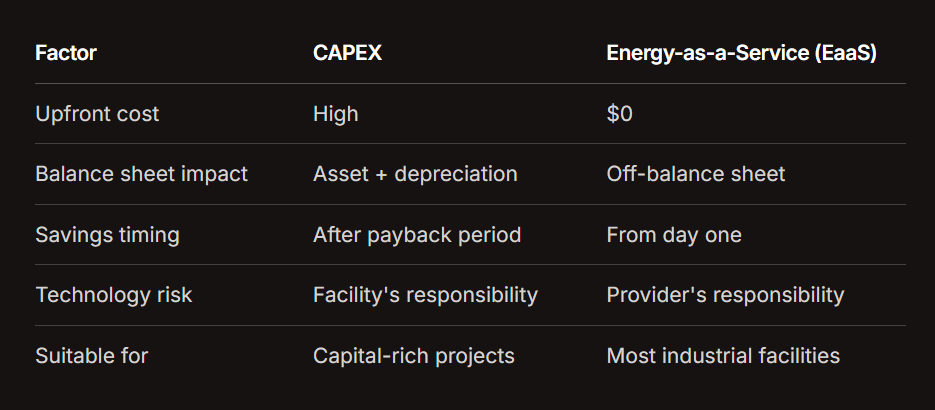
The right starting point isn't a funding decision — it's a feasibility assessment. Understanding your facility's energy profile, demand patterns and integration opportunities is what makes the Business Case credible, whether you pursue CAPEX or EaaS. A structured assessment is low-risk, high-value and typically the step that turns fragmented energy costs into a solvable problem.

