2025-2027 Global Gas Security Report: Strait of Hormuz Volatility and the Australian Industrial Outlook
Executive Summary: The Hormuz-Australia Energy Nexus
The Strait of Hormuz is the single most consequential energy chokepoint on earth — and Australian industrial energy costs are directly tied to what happens there.
Approximately 20% of global LNG trade transits this 33-kilometer passage between Iran and Oman. A sustained disruption doesn't just affect Middle Eastern exporters. It reprices gas globally, and Australia's industrial gas market is not insulated from that signal.
Australian manufacturers, food processors, and heavy industry users largely source gas domestically. But domestic prices don't operate in isolation. Through spot price parity with Asian LNG benchmarks — particularly the Japan Korea Marker (JKM) — Hormuz gas prices transmit directly into Australian contract and spot markets. When Asian buyers compete for alternative supply, Australian east coast gas responds accordingly.
The 2025–2027 period represents a window of heightened structural risk:
LNG supply tightness as new liquefaction capacity lags demand growth across Asia
Geopolitical instability in the Persian Gulf affecting approximately one-fifth of seaborne LNG volumes
Australian domestic price exposure through JKM linkage and export netback pricing mechanisms
Extended spot market volatility with limited near-term demand-side response options for industrial buyers
The following sections quantify these exposures using current trade flow data and project the likely impact on Australian industrial energy costs through 2027.
Headline Findings: 2025-2027 Energy Security Benchmarks
The Strait of Hormuz natural gas supply chain impact is measurable, concentrated, and directly relevant to what Australian industrial operators pay for energy through 2027.
According to the U.S. Energy Information Administration, 83% of all LNG transiting the Strait of Hormuz flows to Asian markets — the same markets that set the benchmark pricing Australian exporters and domestic gas users compete against. And India's exposure is even more acute: approximately 90% of its LPG imports pass through the Strait. A sustained disruption doesn't just affect one buyer — it reprices the entire regional supply curve.
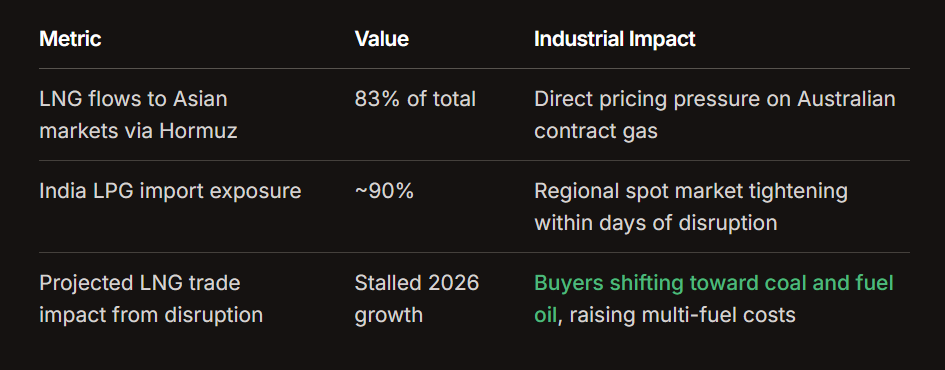
Concentration risk is severe. No alternative deepwater route exists at comparable scale for Middle Eastern LNG volumes — rerouting via Cape of Good Hope adds 10–15 days transit and significant freight cost.
Asian spot prices transmit to Australian contracts faster than most operators anticipate, particularly for manufacturers on pass-through tariff structures.
A blockade scenario — even partial — risks structural disruption to 2026 LNG trade flows, compressing supply options precisely when demand is rising across Japan, South Korea, and Southeast Asia.
The 2026 timeline is not hypothetical. The next section examines why the crude and gas markets may be approaching a simultaneous inflection point.
The 2026 Crude and Gas Crisis: Timing and Triggers
Hormuz LPG price volatility in 2025–2027 represents the most concentrated supply-side shock to hit global energy markets since the post-Ukraine gas crisis — and the timing window for Australian industrial operators is narrowing.
Brookings Institution analysis identifies the crude crisis as a near-term structural event, not a distant tail risk. Crude disruptions through Hormuz carry an immediate spillover into gas markets — not because oil and gas prices move in lockstep, but because shared infrastructure, tanker capacity, and regional refining all face simultaneous strain.
Key Trigger: Gas prices are increasingly decoupling from oil benchmarks, but they're not falling. Infrastructure bottlenecks — regasification terminals, LNG shipping lanes, and onshore pipeline constraints — are keeping delivered gas prices elevated regardless of crude movements. As GIS Reports notes, the Hormuz shock has triggered a structural reset in global gas supply chains that won't unwind quickly.
The U.S. export picture adds another variable. Reddit commodity analysts note that while domestic U.S. gas prices haven't spiked, export terminal constraints limit how quickly American LNG capacity can backfill Asian and European shortfalls. As Simon Flowers of Wood Mackenzie observed, the consequences for gas and LNG "could rival those that followed Russia's invasion of Ukraine in 2022."
That's the crude and LNG picture. But for Australian facilities reliant on LPG — particularly regional and industrial sites — the exposure profile is sharper still.
LPG Volatility: The Hidden Risk for Australian Facilities
LPG supply chain concentration creates immediate physical shortage risk that crude oil exposure does not — and that gap is directly relevant to the Australian East Coast gas shortage outlook through 2027.
LPG has fewer alternative maritime routes than crude oil, meaning a Hormuz disruption translates faster into physical unavailability, not just price spikes.
Unlike crude, which moves through multiple corridors including the Cape of Good Hope and Suez Canal, LPG infrastructure is purpose-built around Hormuz transit. Regional import hubs in Asia-Pacific carry up to 90% import exposure to Hormuz-transiting supply — a concentration with no short-term workaround. Rerouting LPG requires specialized vessels, compatible terminal infrastructure, and longer lead times than crude diversion. In practice, those alternatives don't exist at the scale required.
The consequence for Australian industrial facilities is direct. Sites that rely on LPG for process heat — including food processing, manufacturing, and chemical operations — face supply interruptions that can't be bridged by spot purchasing alone. Price is only part of the problem; the UNCTAD analysis of Hormuz disruptions confirms that physical availability, not just cost, becomes the binding constraint during chokepoint events.
"LPG supply chains are more concentrated than crude, with fewer alternative maritime routes available during a Hormuz blockade." — Discovery Alert
That physical supply risk compounds what's already a structurally tight domestic market — a pressure point the next section examines in detail.
The Australian East Coast Shortage: A Compounding Threat
Australian industrial facilities face a structural gas shortage that global spot price surges are actively accelerating — and the 2025–2027 window represents the highest-risk period in a decade.
When LNG spot prices spike on global markets, Australian exporters face a straightforward commercial incentive: divert domestic-bound supply toward higher-paying overseas buyers. As AEMO and industry analysts confirm, high global spot prices incentivize Australian exporters to prioritize overseas shipments, directly exacerbating East Coast domestic shortages. The mechanism is structural, not incidental.
When export netback prices exceed domestic contract prices, domestic supply shrinks — and East Coast industrial users absorb the shortfall.
The near-term availability outlook is unfavorable across several dimensions:
Export diversion risk: Sustained Hormuz-driven spot price premiums increase the financial incentive to redirect gas away from domestic contracts
Supply-side tightening: Declining legacy field output on the East Coast is reducing the domestic buffer available during export demand surges
Spot price exposure: Facilities without long-term contracts face price volatility directly linked to global LNG disruptions
Physical shortage risk: Unlike crude oil, LNG infrastructure constraints can translate price shocks into actual curtailment events
For Australian industrial sites, genuine industrial energy security Heat Pump transition planning is no longer a medium-term consideration. Demand Reduction — through electrification and thermal alternatives — is now the most reliable hedge against both price and availability risk. The strategic question isn't whether to reduce gas dependence, but which technologies deliver the fastest Payback Period. That's where the next section focuses.
Strategic Response: Heat Electrification and System Integration
Industrial facilities that electrify process heat can reduce gas exposure by up to 80%, turning supply chain volatility from an operational threat into a manageable variable.
The structural gas shortage detailed in previous sections has a practical engineering response. Industrial Heat Pumps are the primary defense — they displace gas-fired process heat with grid electricity, cutting direct LNG dependence without compromising output temperatures or process continuity. In practice, this isn't a theoretical upgrade; it's a commercially quantifiable Demand Reduction that changes the risk profile of your facility.
Three integrated priorities define the strongest business case:
Electrify: Replace gas-fired boilers and direct-fired heaters with Industrial Heat Pumps for Process Heat applications. Payback Periods in manufacturing and food processing environments typically track well against gas price escalation scenarios.
Store: Add Thermal Storage to decouple heat generation from peak electricity tariffs, capturing off-peak rates and smoothing operational costs.
Optimize: Integrate Heat Electrification with a Battery Energy Storage System (BESS) and Commercial Solar for system-level Energy Optimisation — not siloed upgrades.
The CAPEX barrier is real. But Energy-as-a-Service (EaaS) converts these capital projects into operational expenditure, with Operational Savings funding the deployment. And the underlying data driving these projections — including UNCTAD's transit volume analysis and regional LNG market reporting — is worth examining closely before building any energy strategy.
Methodology and Data Sources
This report synthesizes maritime transit data, global energy analyst projections, and Australian domestic market outlooks across a 2024–2027 reporting window— providing operations managers with a grounded basis for evaluating gas supply risk and the business case for Heat Electrification.
Quantitative claims draw on the following primary sources:
UNCTAD — Strait of Hormuz Disruptions: Implications for Global Trade and Development: Maritime transit volume data (Bcf/d) and trade flow modeling underpinning the 20% global supply exposure figure.
GIS Reports — Global Gas Markets After the Hormuz Shock: Spot price correlation analysis and structural supply chain shift projections through 2027.
Congressional Research Service — Iran Conflict and the Strait of Hormuz: Geopolitical risk framing and historical precedent for transit disruption scenarios.
Grand View Research — Hormuz Crisis: Structural Shift in Global Oil and Gas Supply Chains: LPG regional transit exposure estimates and demand-side response modeling.
Editorial Methodology: Supporting data synthesized from maritime transit logs, global energy analyst projections, and Australian domestic market outlooks.
The reporting window covers 2024 historical data with forward projections through 2027. Spot price correlations are assessed against Bcf/d transit volumes recorded through the Strait of Hormuz. Australian LPG exposure figures reflect regional import dependency rather than domestic production baselines. Projections carry inherent uncertainty; operations managers should treat 2027 supply and price estimates as planning ranges, not fixed forecasts.
The next section consolidates the report's core findings into direct actions for operations teams.
Key Takeaways for Operations Managers
The Strait of Hormuz represents a structural overhead risk for Australian industrial energy costs — not a temporary market event. With roughly 20% of global gas supply transiting a single chokepoint, any escalation translates directly into Australian input cost pressure, often with little warning.
Hormuz exposure is an industrial overhead problem. The strait's role in global supply means disruptions flow through to Australian gas tariffs within weeks, not quarters. Operations managers should treat this risk as a baseline planning assumption for 2025–2027.
LPG carries disproportionate risk. With approximately 90% of LPG supply to key regional buyers transiting the Gulf, LPG-dependent facilities face sharper price spikes than those on piped or domestic gas. Exposure analysis should separate LPG and LNG risk profiles.
Heat Electrification is the primary risk-reduction lever available now. As noted in UNCTAD's trade disruption analysis, supply chain restructuring takes years. Industrial Heat Pumps and Thermal Storage can reduce gas demand materially within a single capital cycle.
As Geckon's industrial strategy notes, "industrial energy security is now a function of system-level integration and gas-demand reduction." For operations managers, the 2025–2027 window is the time to assess feasibility — not wait for the next price event to force the decision.
Evaluate your site's gas exposure and build a Business Case for Heat Electrification before market conditions narrow your options.

