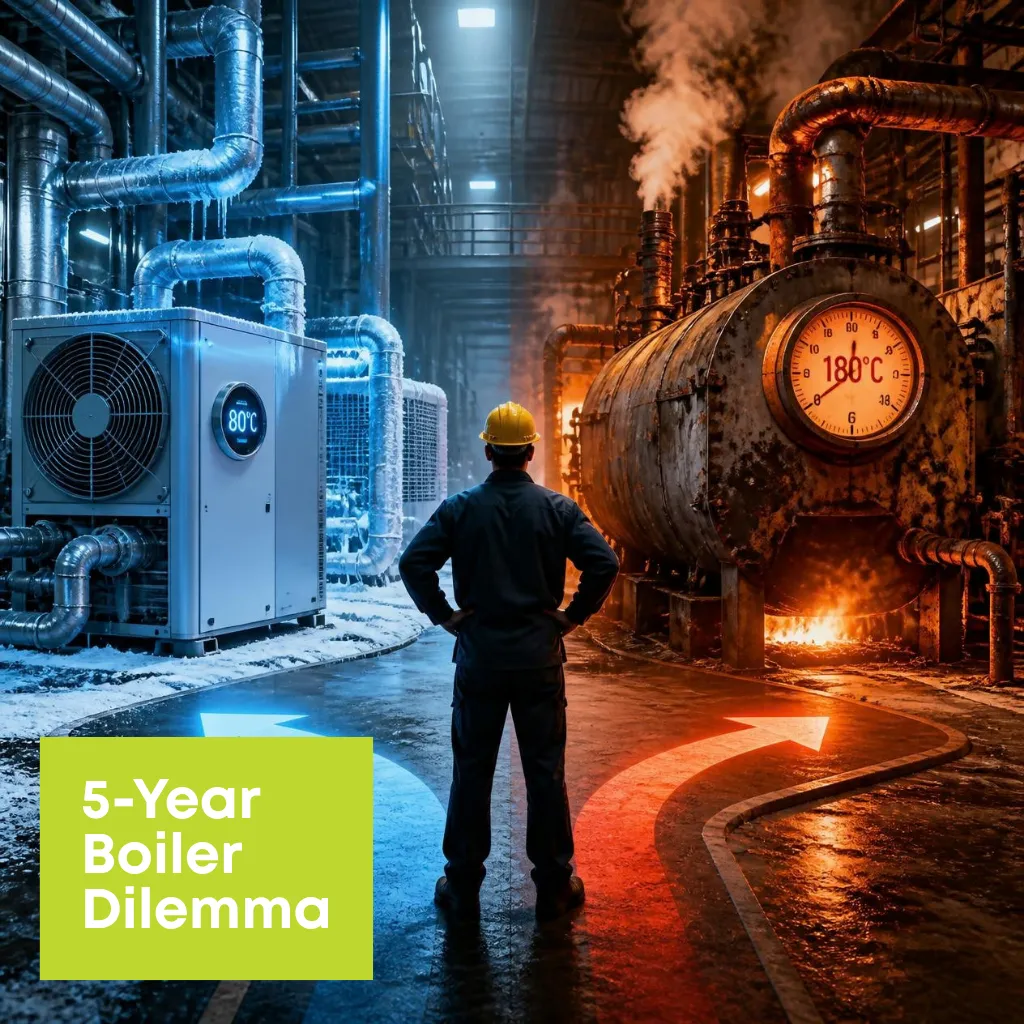
The 5-Year Boiler Dilemma: Why Sub-100°C Process Heat Demands a Heat Pump Now
The Sunk Cost Fallacy of the Five-Year-Old Boiler
A five-year-old boiler isn't a long-term asset — it's a liability with a warranty still attached. Deferring electrification due to a recently installed boiler can be a costly decision in today's energy market.
Sunk cost thinking is the real obstacle here. The capital already spent on a gas boiler is gone regardless of what happens next. The only decision that matters is whether continuing to run that boiler — versus transitioning to an Industrial Heat Pump — is the better economic choice from this point forward. When you frame it that way, the comparison shifts from "we just bought it" to "what does each option cost us over the next decade?"
The sub-100°C process heat range is where this argument is most compelling. Low-temperature process heat — food processing, beverage production, dairy, pharmaceutical, light manufacturing — represents a significant share of industrial energy consumption, and it's the segment where the industrial heat pump vs gas boiler efficiency gap is widest. According to the IEA, even a new boiler loses meaningful energy through flue gases, while a heat pump moves existing heat rather than generating it from combustion.
That thermodynamic distinction — moving heat versus burning fuel to create it — is what underpins the entire business case for acting now rather than waiting for your boiler to fail. The following section explains why this gap is pronounced below 100°C.
Thermodynamics of the 100°C Sweet Spot
If you're asking whether you should replace your boiler with a heat pump, the temperature your process actually needs is the most important number in that decision.
Most industrial and commercial heating loads — pasteurization, food processing, cleaning, space heating, low-pressure steam pre-heating — operate below 100°C. That range is exactly where an Industrial Heat Pump performs at its best. The reason comes down to a concept called the Coefficient of Performance (COP): the ratio of heat energy delivered to electrical energy consumed. A gas boiler converts fuel to heat at roughly 80–95% efficiency — meaning you get, at best, 0.95 units of heat per unit of energy in. An Industrial Heat Pump operating in the same temperature range delivers a COP of 3.0 to 5.0, according to the International Energy Agency. That's 300–500% effective efficiency.
Consider this comparison: A gas boiler at 90% efficiency returns $0.90 of heat per $1.00 of energy cost. A heat pump at COP 4.0 returns $4.00 of heat per $1.00 of electricity cost.
The physics behind this gap is "low lift" — the smaller the temperature difference between the heat source (ambient air, water, or waste heat) and the target process temperature, the less work the compressor does, and the higher the COP climbs. Pushing fluid to 70°C costs the system far less than pushing it to 160°C. This makes sub-100°C Process Heat the easiest load to electrify and provides a strong Business Case. And it's why the gap between gas and electricity costs — not just the technology itself — ultimately determines your Payback Period.
That cost gap is where Australian operators face a distinct and growing exposure, which the next section addresses directly.
Escaping the Australian Gas Price Rollercoaster
Gas price volatility is now a structural business risk, not a temporary market condition — and building your process heat strategy around it is the wrong bet.
Australian industrial spot gas prices have reached$20–$30/GJ in recent years, according to ACCC Gas Inquiry Reports. That's not a peak anomaly. It reflects tightening east coast supply, LNG export competition, and infrastructure constraints that aren't going away. Contrast that with behind-the-meter solar generating electricity at $0.04–$0.06/kWh— a cost that doesn't fluctuate with geopolitical events or pipeline politics. For sub-100°C applications, low temperature process heat electrification via an Industrial Heat Pump converts that stable, cheap electricity into delivered heat at a fraction of the gas equivalent cost.
The hedge argument is also compelling. A carbon mechanism — whether a formal tax or an expanded safeguard scheme — would materially erode the economics of any gas asset still operating in 2030. A business that retires gas infrastructure today avoids that exposure entirely. And with gas supply constraints increasingly common across the east coast grid, locking in a fuel that becomes scarcer over time isn't a conservative position — it's an accumulating liability.

The Business Case for early retirement of a gas boiler, even a recently installed one, rests on this asymmetry. The ongoing fuel cost savings, reduced carbon exposure, and lower maintenance burden of an electrified system can outweigh the residual asset value faster than most finance teams expect. But the calculation changes further when that Industrial Heat Pump isn't operating as a standalone unit replacement. How you integrate it with the rest of your energy system is where the real Operational Savings emerge — and that's exactly where Thermal Storage enters the picture.
The Thermal Battery: Integration as a Force Multiplier
Replacing a boiler unit-for-unit with an industrial heat pump misses the larger commercial opportunity — the real gains come from designing Thermal Storage, solar generation, and heat pump operation as a single engineered system.
When you treat these three components as one system, the economics improve substantially. A heat pump running at its best heat pump COP under 100 degrees doesn't operate in isolation — it charges a Thermal Storage buffer during the hours when rooftop solar is generating at full output. As Beyond Zero Emissions notes, integrating Thermal Energy Storage with heat pumps allows facilities to shift heating loads to periods of peak solar generation, directly reducing grid electricity consumption during expensive peak-rate periods.
In practice, this "Solar-Pump-Storage" workflow operates in three distinct phases:
Solar generation hours (roughly 9am–3pm): The industrial heat pump runs at maximum capacity, drawing cheap or near-zero-cost solar electricity to charge insulated Thermal Storage tanks to your required process temperature.
Off-peak and evening hours: Stored thermal energy discharges to meet process heat demand, with the heat pump cycling down or switching off entirely — eliminating consumption at higher grid tariff rates.
Demand Reduction benefit: Because the heat pump load is shifted away from peak demand windows, your maximum demand charge on your electricity bill also falls, compounding the Operational Savings beyond simple energy substitution.
This "Engineered as One System" philosophy changes the payback calculation meaningfully. You're no longer evaluating just fuel cost displacement — you're stacking Demand Reduction, tariff arbitrage, and solar self-consumption into a single business case. The individual components are commercially proven; the value comes from how they're sized and sequenced together.
That integrated business case, however, still requires capital — and for facilities with assets that aren't yet fully depreciated, that creates a real friction point. How you fund the transition matters as much as the technology itself.
Overcoming the CAPEX Hurdle: Energy-as-a-Service
Replacing a functional asset before it reaches end-of-life is a hard sell — even when the business case for switching is clear.
Balance sheet impact is the most common reason facility managers pause. A boiler installed five years ago still carries depreciated value. Writing it off early, then funding a new industrial heat pump system, means absorbing two financial hits simultaneously. For sites already managing tight capital budgets, that conversation stalls before it starts. And for industrial energy system integration across Australia, where multi-site businesses face competing CAPEX priorities, this hesitation plays out repeatedly.
Energy-as-a-Service (EaaS) removes this barrier entirely. Under an EaaS model, a provider designs, installs, owns and maintains the heat pump and thermal storage infrastructure — and the site pays a fixed or consumption-based service fee instead of a capital outlay. There's no asset on your balance sheet and no upfront spend.
EaaS for industrial sites: A contractual model where energy infrastructure is delivered as a managed service, funded through operational savings rather than capital expenditure.
Operational savings fund the transition directly. Because industrial heat pumps typically deliver process heat at three to five times the efficiency of gas boilers, the reduction in energy spend covers the service fee — often from day one. What previously appeared as a CAPEX problem becomes an OPEX-neutral or OPEX-positive outcome.
Performance risk also shifts. Under a well-structured EaaS agreement, the provider is accountable for system uptime, output targets and efficiency guarantees. That's a material difference from purchasing equipment outright and absorbing any underperformance yourself. Understanding what that risk transfer is worth — and how it compares to total cost of ownership over a 10–15 year horizon — is exactly where the numbers get interesting.
The Bottom Line: Why Sub-100°C Heat is the Priority
For Australian manufacturers running sub-100°C process heat, industrial heat pumps aren't a future consideration — they're the highest-return energy decision available right now.
According to ARENA's analysis of renewable energy for process heat, low-temperature process heat under 100°C is the clear sweet spot for industrial heat pump ROI. The physics are straightforward: heat pumps deliver 3–5x more usable heat energy per unit of electricity consumed compared to a gas boiler operating at equivalent temperatures. When that electricity comes from on-site commercial solar, the operational savings compound across a 20-plus year asset life — locking in a cost floor that gas simply can't match.
The age of your boiler is not the right question. Total cost of ownership is.A boiler with five years of service life remaining still represents five more years of exposure to gas price volatility, carbon cost risk, and maintenance spend. The business case for transition is built on TCO, not on waiting for end-of-life to force the decision.
The two barriers most facilities cite — upfront capital and integration complexity — are both solvable. Thermal storage smooths the mismatch between when solar generates and when heat demand peaks, making the system commercially viable around the clock. And Energy-as-a-Service (EaaS) removes the capital expenditure entirely, converting the project into a predictable operating cost with savings from day one.
Taken together, these aren't incremental improvements to your energy position. They're structural changes that reduce your exposure to input cost uncertainty for decades. The practical question isn't whether the economics stack up — it's whether your facility's specific load profile, temperature requirements, and gas consumption make this the right moment to act. That's exactly what a site-level assessment is designed to answer.
Evaluating Your Facility's Electrification Potential
The most important step before replacing any boiler asset is understanding what your gas is actually doing — and whether an Industrial Heat Pump can do it better.
Start with a structured audit of your current gas consumption. Map your temperature requirements process by process. For most Australian manufacturers, a significant portion of that load sits below 100°C — in washing, rinsing, pasteurisation, drying or pre-heating applications — where heat pump technology delivers the strongest economics. Understanding your load profile is essential for building a credible Business Case.
Site-level integration matters more than equipment selection alone. Swapping a boiler for a heat pump without addressing controls, thermal storage, or grid connection isn't an upgrade — it's a substitution. System-level integration ensures that your heat pump, Battery Energy Storage System, solar generation and process controls work together as one cohesive, high-reliability system. This determines whether you achieve the promised Operational Savings.
For Australian manufacturers, acting now isn't just about energy costs — it's about competitive positioning. Gas prices won't stabilise, and businesses that lock in Heat Electrification infrastructure at today's costs will carry a structural cost advantage into the next decade.
Gas price spikes are unpredictable. Consider these steps to prepare:
Audit your gas use by temperature band and process type
Identify your highest-return applications— typically sub-100°C, high-utilisation loads
Evaluate site integration requirements including electrical capacity, controls and Thermal Storage
Assess funding options, including Energy-as-a-Service to avoid upfront capital commitment
Assess your facility's electrification potential now — before your next capital decision locks in another decade of gas dependency.

