Escaping the Gas Death Spiral: Why Australian Manufacturers Must Electrify Process Heat Before 2028
The 2028 Horizon: Why the East Coast Gas Shortfall is Different This Time
Australian manufacturers that have absorbed gas price increases as a temporary disruption need to reassess that assumption. The east coast gas shortfall industrial impact is no longer a forecast risk — it's a confirmed trajectory with a defined timeline.
The AEMO 2024 Gas Statement of Opportunities confirms that peak winter demand on the East Coast will exceed available supply as early as 2028.That's a physical constraint, not a pricing anomaly. Southern states — Victoria in particular — carry the highest exposure, given their dependence on aging Bass Strait fields and limited access to new supply infrastructure.
The pricing shift compounds the supply problem. Industrial gas users have already seen spot prices spike consistently above $12/GJ, compared to the historical norm of $4–$6/GJ tracked by the ACCC Gas Inquiry. That doubling isn't a cycle peak waiting to correct. The structural economics of Australian gas — including LNG export parity pricing and declining domestic reserves — have established a new permanent floor.
The case for waiting on new gas supply to relieve industrial costs doesn't hold up under scrutiny. New projects face long development timelines, capital requirements and regulatory hurdles that put meaningful relief well beyond 2028. Manufacturers who are designing energy strategy around lower future gas prices are building a business case on an assumption the market no longer supports.
Understanding why that matters for your cost structure starts with the mechanism driving prices up — a dynamic that makes inaction increasingly expensive, which we'll examine next.
Understanding the Death Spiral: The Financial Trap for Industrial Users
The gas death spiral in Australian manufacturing is an economic mechanism, not a metaphor — and understanding how it works explains why waiting is the costliest strategy available.
The core dynamic is straightforward. Gas network infrastructure — pipelines, compressor stations, metering systems — carries largely fixed costs regardless of how much gas flows through it. As electrification by residential and small commercial users reduces total gas consumption, those fixed costs are redistributed across a shrinking customer base. According to the Grattan Institute, as electrification reduces the total volume of gas transported, regulated asset base costs are spread across fewer gigajoules, leading to higher per-unit network tariffs.
Industrial manufacturers, as high-volume users, absorb a disproportionate share of those rising tariffs— and therein lies the trap. Each price increase accelerates the exit of smaller users, which in turn pushes network costs higher again. The cycle compounds.
"The risk of a 'death spiral' for gas networks is real... potentially leaving the last remaining customers — often industrial users — with unsustainable costs." — Tony Wood, Grattan Institute
Manufacturers who remain connected become captive customers to what is effectively a stranded asset: infrastructure that carries increasing financial liability with diminishing commercial justification. The longer a site delays action, the narrower its options become — and the weaker its business case for transition looks against a rising cost baseline.
The question, then, isn't whether to electrify process heat. It's how to do it in a way that genuinely delivers Operational Savings rather than simply swapping one cost exposure for another. That distinction — between a simple equipment swap and an integrated energy system— is where the real value sits.
Beyond the Boiler: The Case for Integrated Heat Electrification
Replacing a gas boiler with an electric one is the wrong starting point — the real gains come from treating heat, power, and storage as a single engineered system.
Commercial heat pump integration for gas replacement only delivers its full ROI when it's designed as part of a broader energy system, not bolted on as a direct swap. A like-for-like replacement typically captures less than half the available efficiency improvement because it ignores the thermodynamic opportunities already present in most manufacturing processes — waste heat streams, load-shifting potential, and demand reduction levers that remain untouched when engineering stops at the equipment level.
industrial heat pumps are the foundation of effective Heat Electrification. Rather than generating heat from scratch, they capture low-grade waste heat from exhaust air, cooling circuits, or process condensate and upgrade it to usable process temperatures. In well-designed systems, this approach delivers two to four units of thermal output for every unit of electricity consumed — a fundamental shift in the cost structure of process heat.
thermal storage acts as the financial buffer that makes electrification commercially viable at scale. By storing heat during off-peak periods when electricity tariffs are lower and discharging it during peak pricing windows, thermal storage directly reduces exposure to volatile electricity spot prices — a critical consideration as grid pricing grows more complex.
System-level controls tie these components together, continuously optimizing dispatch decisions across heat pumps, storage, and site loads. This integration is what separates a credible business case from a component-purchasing exercise.
The challenge for most manufacturers isn't identifying these technologies — it's funding the capital required to deploy them without straining the balance sheet. That's where the financing model becomes as important as the engineering, which the next section addresses directly.
Solving the CAPEX Hurdle with energy-as-a-service (EaaS)
The single biggest barrier to electrifying process heat isn't technical — it's financial. Industrial heat systems represent significant capital, and replacing them requires investment that competes directly with core production priorities. Financing industrial energy transitions with EaaS removes that barrier by converting a large upfront capital expense into a predictable operational cost.
Traditional CAPEX means the site owns the asset, carries the debt, absorbs cost overruns, and manages performance risk. If the system underperforms, that's an internal problem. If technology improves six months after commissioning, the site is locked in. The balance sheet takes the hit from day one.
energy-as-a-service works differently. The service provider funds, installs, and operates the electrification assets — industrial heat pumps, thermal storage, or integrated BESS — and the site pays a monthly service fee. That fee is structured to be lower than the gas costs it displaces, meaning savings begin immediately without capital deployment.
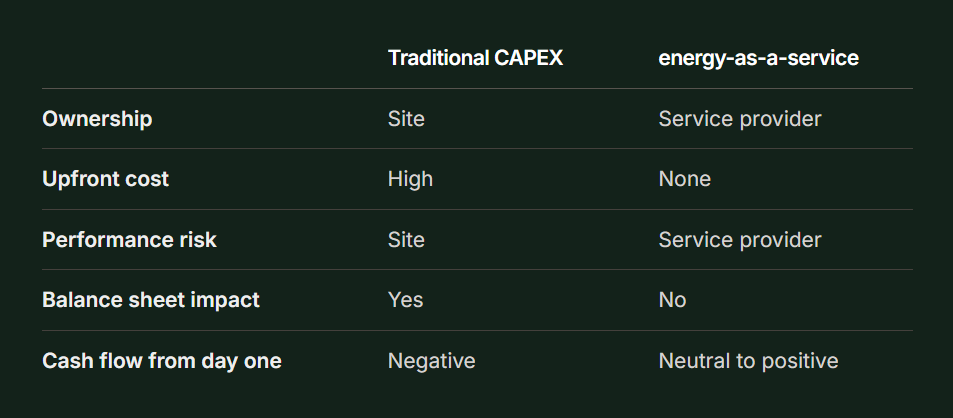
This structure also transfers technical and operational risk. If equipment fails or underperforms, remediation is the provider's responsibility — not a maintenance budget problem for the site. For manufacturers already navigating thin margins under rising gas costs, that risk transfer has real commercial value. The next question is how electrification also reduces exposure to the gas price volatility that makes planning so difficult in the first place.
Operational Resilience: Decoupling Manufacturing from Global Gas Volatility
Gas price certainty is no longer available to Australian manufacturers — and the structural reasons behind that fact won't reverse before 2028.
The core problem is pricing linkage. Domestic gas prices in Australia are increasingly tied to international LNG netback prices, meaning local manufacturers effectively compete with Asian export markets for their own energy supply. As the ACCC has documented, domestic supply constraints have hardened this linkage, making gas-heavy operational models commercially exposed to geopolitical events — conflicts, supply disruptions, or demand surges on the other side of the world — that manufacturers have no ability to influence or hedge against.
Price Sovereignty is what electrification actually delivers. When a facility pairs an Industrial Heat Pump with on-site commercial solar and a Battery Energy Storage System (BESS), a meaningful portion of its energy cost becomes fixed, predictable, and domestically controlled. That's a fundamentally different risk profile from one locked to floating LNG benchmarks. In practice, facilities that generate and store their own electricity shift from price-takers to price-setters for a portion of their energy base — reducing exposure to the next geopolitical shock before it hits the invoice.
There's also a supply chain dimension worth noting. Global buyers — particularly in Europe and North America — are increasingly applying thermal storage and carbon criteria to supplier qualification. A facility with demonstrable Heat Electrification and low-emission process heat production gains a competitive edge in those conversations. Exploring energy-as-a-service for industrial decarbonisation removes the capital barrier entirely, meaning Operational Savings and supply chain positioning don't have to wait for a major budget cycle.
The next section pulls together the key decisions facility leaders need to make — and the timeline that makes acting now, not later, the commercially sound choice.
The Bottom Line: Key Takeaways for Facility Leaders
Australian manufacturers face a narrowing window: act on Heat Electrification before 2028 or absorb gas costs that will keep rising regardless of what commodity markets do.
The sections above have built a clear picture — from the structural economics of the gas death spiral to the operational case for integrated energy systems and the financial flexibility that energy-as-a-service (EaaS) provides. Here's what that means in practice for facility leaders making planning decisions today:
The 2028 deadline is structural, not speculative. AEMO's 2024 GSOO projects that peak winter demand could exceed supply capacity in southern states within four years. That timeline maps directly onto infrastructure procurement and installation lead times.
Gas costs will rise even if spot prices don't. The death spiral dynamic — declining grid demand driving up fixed-cost recovery — means network charges keep climbing independent of commodity prices.
Integrated systems deliver the strongest business case. Combining industrial heat pumps with thermal storage compounds efficiency gains and reduces peak Demand Reduction exposure simultaneously.
EaaS removes the capital barrier. Facilities don't need to choose between maintaining working capital and electrifying process heat — the two are no longer mutually exclusive.
The question isn't whether to make this transition. It's whether your site has the right data to make it confidently — which is exactly where the process starts.
Starting the Transition: From Feasibility to Integration
The manufacturers that move forward successfully on Heat Electrification don't begin with technology selection — they begin with a clear picture of their site's energy profile.
A site-level energy audit is the essential first step. Before any business case can be built, facility leaders need to understand their current gas consumption patterns, process temperature requirements, load timing, and the realistic renewable generation potential available on-site. Without this foundation, technology recommendations are speculative rather than grounded in commercial reality.
The audit should map the intersection of two critical variables: what your process heat demands look like across hours, days, and seasons — and what solar, battery, or thermal storage capacity your site can practically support. An Industrial Heat Pump sized correctly for your load profile, paired with commercial solar and a Battery Energy Storage System (BESS), delivers materially different economics than a system designed without that integrated analysis. Getting this intersection right is where savings are either realized or lost.
Choosing the right delivery partner matters at this stage. Geckon approaches heat and power as a single engineered system, offering both EPC and energy-as-a-service (EaaS) models — which means the commercial structure can be matched to your capital position, not the other way around.
Before requesting a full project proposal, consider evaluating your site against these criteria:
Current gas spend and price trajectory— what's your annual exposure and what does it look like at 2027 pricing?
Process temperature requirements— which loads are compatible with electrification today?
Roof or land area available— what's the viable commercial solar and storage footprint?
Operational constraints— what downtime tolerance exists during integration?
Capital vs. operating preference— does EaaS or direct ownership suit your balance sheet?
Answering these questions before engaging an engineering partner will sharpen the scope, reduce feasibility costs, and produce a business case grounded in your actual site conditions. Explore Geckon's approach to industrial heat pumps and integrated energy solutions to understand what a site assessment typically covers and what outcomes to expect.

