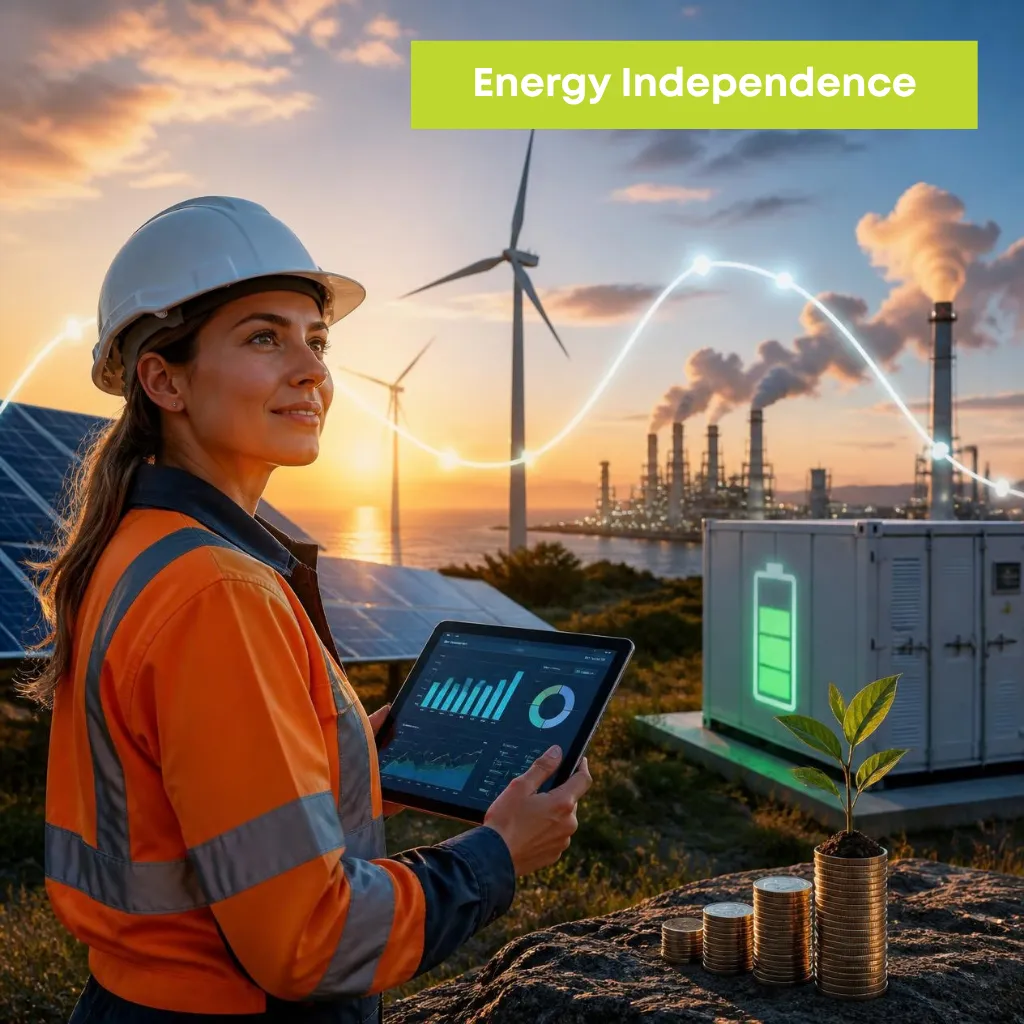
Why Energy Independence is the Only Hedge Against Australia's Volatile Industrial Tariffs
The New Reality of Australian Industrial Energy Costs
Mitigating Australian industrial electricity price volatility is no longer a procurement exercise — it's a strategic business decision with direct implications for margin, competitiveness, and operational continuity.
Energy independence, in an industrial context, means generating and managing enough on-site energy to insulate your facility from the structural instability of grid-supplied power. It's not about disconnecting from the grid entirely. It's about reducing your exposure to a market that has demonstrated it cannot deliver predictable pricing at the scale manufacturers require.
The numbers illustrate the gap clearly. Wholesale electricity prices in the NEM averaged $105.62/MWh in late 2024, while gas-only generation costs reached $250.30/MWh — a disparity that exposes facilities locked into conventional energy supply to costs that bear no relationship to underlying generation economics. Site-generated energy from solar, battery storage, or industrial heat pumps doesn't fluctuate with fuel markets or network congestion events. Once capital is committed, the cost of that energy is largely fixed and foreseeable.
As the Perth USAsia Centre has noted, "a nation cannot claim industrial sovereignty while remaining vulnerable to energy shortages, fuel insecurity, or electricity system instability." The same logic applies at the facility level. Businesses that depend entirely on grid-supplied power during peak periods are exposed not just to wholesale price spikes, but to a network tariff structure that is shifting cost burdens onto industrial users in ways that retail contract negotiations simply can't resolve. That's the problem the next section addresses directly.
How Network Tariff Changes Undermine Manufacturing Margins
Network charges are the hidden driver of industrial electricity cost spirals — and most facilities have far less control over them than they realize.
Understanding your bill starts with recognizing that it has two distinct layers. The retail component covers the energy commodity itself — what you pay per kilowatt-hour for electricity supply. The network component funds the physical infrastructure: the poles, wires, substations and transformers that deliver power to your site. According to Sustainable Energy Solutions, network charges typically account for30% to 50% of a commercial or industrial electricity bill in Australia. And unlike retail rates, network tariffs are set by regulators — they sit almost entirely outside what you can negotiate with your energy retailer.
What makes network charges particularly difficult to manage is how they respond to consumption behavior. Tariff structures are designed to recover infrastructure costs based on when and how intensively you draw power. The factors that commonly push facilities into higher tariff brackets include:
Peak demand charges— billed on your highest 30-minute demand interval during peak windows, often disproportionate to actual energy use
Time-of-use network rates— penalizing grid consumption during morning and evening peaks
Capacity-based thresholds— where crossing a demand limit triggers a higher bracket for the entire billing period
Reactive power charges— applied when equipment draws power inefficiently, adding cost without adding productive output
The commercial risk here is compounding. A facility that expands production, adds equipment or shifts to a new operating schedule can inadvertently cross a network tariff threshold — triggering materially higher charges across every subsequent billing period. This is exactly why optimizing industrial load profiles for new tariffs has become a priority for manufacturers who've changed their operations without revisiting their tariff exposure.
Facilities that rely solely on grid-supplied power during peak periods face the greatest vulnerability. There's no buffer between their consumption behavior and the full cost of network infrastructure — every kilowatt drawn at the wrong time is billed at the highest applicable rate. As Australian network businesses continue to recover significant capital investment through tariff structures, the exposure for grid-dependent industrial sites is only increasing. That dynamic doesn't exist in isolation — it's also being shaped by pressures that extend well beyond the Australian regulatory environment.
The High Cost of Global Trade Barriers and Energy Policy
Global trade policy is now a direct input to Australian industrial electricity costs — and facilities that ignore this connection are exposed to risks they can't control or predict.
When import tariffs raise the cost of grid hardware, every industrial electricity user pays more. As Utility Dive and Morningstar analysis confirms, tariffs on essential grid components — transformers, switchgear, solar panels, inverters — slow transmission development and drive up utility capital expenditure. That expenditure doesn't stay with the utility. It flows through to network charges, and ultimately lands on your bill.
Supply chain exposure is the first pressure point. Australian grid infrastructure depends on globally sourced components. When US-led tariff regimes disrupt manufacturing and shipping flows, lead times blow out and capital costs rise. Utilities respond by deferring investment or passing cost recovery through regulated asset bases — both outcomes compound the impact of network tariff changes on manufacturing facilities operating on tight margins.
Policy instability creates the second layer of risk. The so-called Trump effect on global energy markets has demonstrated how quickly domestic political decisions in large economies can reshape component pricing worldwide. Tariffs targeting solar panels and wind components don't just affect American energy projects — they tighten global supply, raise prices for competing buyers, and delay Australian renewable builds that would otherwise lower wholesale generation costs.
Infrastructure cost inflation ties it together. When capital costs rise across the grid, regulators allow higher network revenue recovery. Those increases arrive at the facility gate as demand charges, capacity charges, and connection fees — compounding the broader pressure on industrial operating costs.
What this means practically is that waiting for external policy conditions to improve isn't a viable strategy. The most reliable hedge against this volatility is reducing dependence on grid-delivered energy through site-level generation and storage. And for energy-intensive manufacturers, that hedge starts not just with power, but with heat — which is where the most significant efficiency gains are often found.
Heat Electrification: The Industrial Lever for Cost Control
Industrial heat electrification is one of the most effective industrial energy independence strategies available to Australian manufacturers today— and most facilities are leaving significant savings on the table by treating heat and power as separate utilities.
The efficiency gap between gas boilers and Industrial Heat Pumps is substantial. Gas-fired systems typically convert 50% to 80% of fuel energy into usable process heat. According to IEEFA, Industrial Heat Pumps deliver the same output at efficiencies of 250% to 500% — meaning you extract two to five units of heat for every unit of electricity consumed. That's not a marginal improvement. It's a structural cost advantage, particularly as gas prices remain exposed to global supply volatility.
Process Heat costs drop sharply when Industrial Heat Pumps are paired with behind-the-meter solar, which can deliver electricity at roughly $37.10/MWh — a fraction of what grid peak rates deliver. Where a gas boiler draws on commodity-priced fuel with no load-shifting capability, an IHP running on commercial solar generation turns low-cost electrons directly into heat. The business case strengthens further when you consider that gas tariffs carry their own network and supply components, compounding exposure in ways that electricity-based systems can avoid.
Thermal Storage closes the loop by decoupling when heat is generated from when it's needed. Facilities can charge thermal storage during off-peak tariff windows or peak solar generation periods, then discharge during high-demand production cycles. This load-shifting capability directly reduces peak Demand Reduction exposure — the same network charge mechanism covered earlier in this article. And it does so without interrupting operations.
The practical implication is this: heat and power should be engineered as a single integrated system, not managed as separate line items. That integrated view — combining IHPs, Thermal Storage, Commercial Solar and controls — is precisely what the next section addresses.
Strategies for Optimizing Industrial Load Profiles
True energy independence meaning goes beyond owning a solar array — it's the deliberate engineering of your site's load profile so that grid exposure shrinks and operational savings grow predictably.
The highest-impact starting point is peak demand reduction through a Battery Energy Storage System (BESS).Demand charges can represent a significant share of a facility's total electricity bill, and a single peak event sets the rate for the entire billing period. A BESS absorbs that spike before it hits the meter, directly cutting the demand charge component without changing a single production process.
Advanced controls allow you to take this further by aligning Process Heat cycles with periods of maximum solar generation. Solar-sourced electricity is now among the lowest-cost generation available — renewable sources like solar are clearing at around $37.10/MWh compared to peak grid rates that can be multiples of that figure. Scheduling heat-intensive loads to coincide with that window materially reduces your average cost of energy.
Behind-the-meter generation deserves a formal Business Case evaluation. Network fees are largely fixed regardless of how much energy you consume — bypassing them through on-site generation is one of the few structural ways to reduce that cost permanently rather than manage it.
And none of this works sustainably without shifting from reactive maintenance to proactive Energy Optimisation. Facilities that monitor, model and continuously tune their energy systems consistently outperform those that treat energy as a utility bill rather than an engineered process. That integrated discipline — solar, storage, Industrial Heat Pumps and controls working as a system — is what the next section distills into clear takeaways for facility leaders.
The Bottom Line: Key Takeaways for Facility Leaders
Energy independence isn't a sustainability goal — it's a cost control strategy, and the commercial case for acting now has never been stronger.
The sections above make one thing clear: waiting for grid prices to stabilize is not a business strategy. Network tariffs alone can represent up to 50% of your total electricity bill, and those charges don't decrease when you use less energy — they're fixed infrastructure fees built into the tariff structure. The only way to bypass them is to generate and manage energy at the site level.
Network tariff exposure is structural, not cyclical. Behind-the-meter generation directly reduces your dependence on grid-delivered energy, which is where the fixed cost sits.
Industrial heat pump efficiency delivers roughly five times the energy output per unit of electricity consumed compared to gas combustion — making Heat Electrification the fastest path to reducing total Process Heat costs.
Global trade and policy pressures are increasing the cost of grid-scale energy infrastructure, making behind-the-meter investment comparatively more attractive, not less.
Integrated systems — Commercial Solar paired with a Battery Energy Storage System and Industrial Heat Pumps — deliver the strongest Business Case because they treat energy as a single engineered process rather than isolated line items.
The facility leaders who move first on integrated energy systems will lock in Operational Savings that compound year-over-year while competitors absorb rising tariffs. The remaining question isn't whether to act — it's how to structure the investment without straining capital budgets, which is exactly where Energy-as-a-Service becomes relevant.
Moving Toward Energy-as-a-Service (EaaS)
Energy independence is achievable for most industrial facilities — but the upfront capital required to integrate Commercial Solar, Battery Energy Storage Systems, Industrial Heat Pumps and Thermal Storage simultaneously is a genuine barrier for many operations.
Energy-as-a-Service Australia is changing that equation. Under an EaaS model, Geckon finances, installs and operates the full energy system on your behalf — you pay for the energy output rather than the infrastructure. The Operational Savings are captured immediately, without committing capital to equipment that sits outside your core business. For facilities facing tariff volatility right now, this matters: the Payback Period becomes someone else's balance sheet risk while the savings flow directly to yours.
And the financial structure is only part of the value. What's often underestimated is the complexity of integrating disparate systems — solar generation, battery dispatch logic, heat electrification controls and demand management — into a coherent whole. An engineering partner who manages that integration removes the operational burden from your team and ensures each technology performs as part of a coordinated Energy Optimisation strategy, not as isolated assets.
The first step isn't a procurement decision — it's a feasibility assessment. Understanding your current load profile, tariff exposure and site constraints takes the conversation from abstract to commercial. If you're ready to evaluate what decoupling from grid volatility could mean for your facility, assess your energy independence opportunity with Geckon today.

