Beyond the Stack: Why High-Temperature Heat Pumps Outperform Condensing Boilers in Australian Industry
The Efficiency Ceiling of Industrial Condensing Boilers
Gas-fired boilers have a hard efficiency ceiling — and most Australian industrial sites are already bumping against it.
Even the best condensing boilers extract only around 97–98% of the chemical energy in natural gas under ideal conditions, and those conditions rarely occur in practice. Standard non-condensing boilers deliberately vent flue gases at temperatures above the dew point to prevent acid corrosion in the heat exchanger. According to the U.S. Department of Energy, this flue gas loss typically accounts for10% to 15% of fuel energy— heat that exits through the stack and disappears entirely.
Condensing boilers recover some of that latent heat by dropping flue gas temperatures below the dew point, but they introduce a significant operational constraint: return water temperatures must stay below approximately 55°Cfor condensing to occur consistently. In practice, many industrial heating circuits operate with return temperatures well above this threshold. When return temperatures rise, the boiler stops condensing, efficiency drops back toward non-condensing levels, and the economic case for the upgrade narrows considerably.
This is sometimes called the "20-degree rule" — the requirement to maintain a meaningful temperature differential between flow and return to sustain condensing operation. For process heating applications with tight temperature bands or high return temperatures, designing around this constraint adds complexity and can compromise process control.
The deeper issue is that no amount of engineering refinement changes the underlying physics. A gas boiler converts fuel to heat at a ratio that cannot exceed 1:1. Every efficiency gain is simply a reduction in waste — not a fundamental improvement in the energy conversion model. That hard ceiling is precisely what positions high temperature industrial heat pumps as a structurally different solution, not just an incremental upgrade. The next section explains how modern heat pump technology breaks through temperature barriers that once made boilers appear irreplaceable.
High-Temperature Heat Pumps: Breaking the 100°C Barrier
Industrial heat pumps vs boilers is no longer a comparison between low-grade heating and high-performance combustion — modern units now deliver process heat up to 160°C.
The limiting assumption has long been that heat pumps are suited to space heating or domestic hot water, not industrial process heat. That assumption is now outdated. According to the International Energy Agency, high-temperature heat pumps (HTHPs) can deliver process heat up to 160°C — making them direct functional replacements for pressurized hot water systems and low-pressure steam boilers.
Advances in refrigerant technology are what make this possible. Next-generation refrigerants, including transcritical CO₂ and high-pressure synthetic blends, allow HTHPs to reach output temperatures that were previously only achievable through combustion. The result is a unit that connects to existing heat distribution infrastructure — the same pipework, headers, and heat exchangers — without requiring a parallel system.
Process Applications
This temperature range opens the door to sectors that have historically been locked into gas. Compatible industrial processes include:
Pasteurizationin dairy and beverage production (typically 72–85°C)
Chemical dryingand solvent evaporation (up to 140°C)
Food sterilizationand blanching
Timber dryingand industrial laundry
The commercial case isn't built on sustainability credentials — it's built on operational savings and payback period. For sites evaluating heat electrification, the relevant question is whether the delivered heat cost per GJ drops. In most cases involving industrial energy projects in Australia, it does. The next step is understanding exactly why — and that starts with how HTHPs produce heat in the first place.
The COP Advantage: Why 400% Efficiency is the New Standard
Heat pumps for high temp industrial heat don't generate thermal energy — they move it, and that distinction is where the business case begins.
The previous section established that modern high-temperature heat pumps can now deliver process heat above 100°C. What that capability translates to, in commercial terms, is an efficiency gap that no combustion system can close. The best condensing gas boiler tops out at around 0.95–0.98 efficiency — meaning roughly 98 cents of every dollar spent on gas becomes usable heat. That's a ceiling, and it's physically fixed by the chemistry of combustion. Industrial heat pumps operate on an entirely different principle.
Rather than burning fuel to create heat, a heat pump transfers thermal energy from a lower-temperature source to a higher-temperature output. That distinction means the system moves three to five units of heat for every unit of electricity consumed. According to ARENA, industrial heat pumps achieve a Coefficient of Performance (COP) of 2.5 to 5.0 — making 250–500% effective efficiency a practical, not theoretical, outcome.
In Australian conditions, where electricity tariffs are increasingly offset by behind-the-meter solar generation, this COP advantage compounds further. A site running commercial solar can supply low-cost electricity to a heat pump during peak generation hours, effectively decoupling Process Heat costs from gas market exposure. When gas prices spike — as they have across eastern Australia since 2022 — the operational savings from switching become more pronounced with each billing cycle.
Waste heat recovery pushes the COP ceiling even higher. Many industrial sites already generate low-grade thermal waste from refrigeration systems, compressors, or exhaust streams. When that waste heat is used as the heat pump's input source rather than ambient air, the temperature lift required is smaller, the compressor works less, and COP improves materially. A site that might achieve a COP of 3.0 on ambient air could realistically reach 4.5 or above when paired with a reliable waste heat stream — directly improving the payback period on capital investment.
The comparison below makes the efficiency gap concrete:
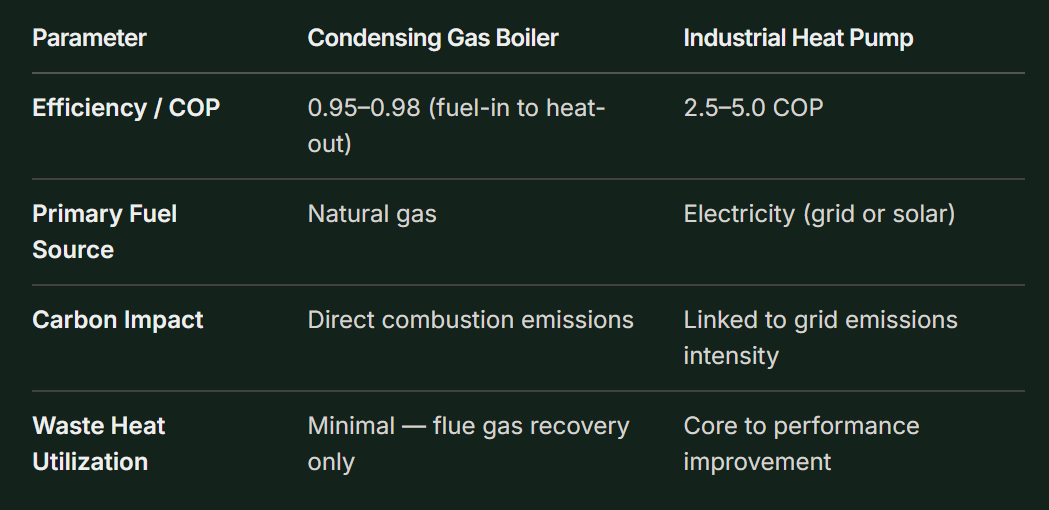
The efficiency advantage isn't marginal — it's structural. And it only strengthens when heat pumps are paired with the right energy optimisation architecture. That's where thermal storage enters the picture.
System Integration: Decoupling Demand with thermal storage
The real advantages of industrial heat pumps emerge not from the unit itself, but from how it's engineered into a broader energy system. A standalone heat pump reduces fuel costs — but pair it with thermal storage and advanced controls, and you've built a platform that actively responds to energy market conditions.
As Beyond Zero Emissions notes, integrating thermal storage with high-temperature heat pumps allows industrial sites to decouple heat generation from demand, maximizing the use of behind-the-meter solar PV. In practice, this means running heat pumps hard during peak solar production hours — when electricity is cheapest — and storing that thermal energy for use during evening peaks or periods of high gas tariff exposure.
System-level thinking turns a heat pump from a cost-reduction tool into an active energy asset.
Advanced controls sit at the center of this approach. They coordinate heat pump operation, thermal storage charge and discharge cycles, and Commercial Solar output in real time. When grid prices spike or gas network tariffs hit their daily peak, the system draws on stored heat rather than firing additional generation capacity. This directly reduces Demand Reduction exposure and smooths energy spend across the billing period.
The commercial outcome is material:
Lower average electricity cost by shifting heat pump operation to off-peak and solar-coincident windows
Reduced gas tariff risk by displacing peak consumption with stored thermal energy
Improved asset utilization as heat pumps run at optimal load rather than cycling to match variable demand
Greater payback period certainty through predictable, scheduled operation rather than reactive dispatch
The integrated system approach does carry a higher upfront design and capital commitment than a direct boiler replacement — and that's worth addressing directly.
Navigating the Transition: CAPEX vs. energy-as-a-service
The biggest commercial barrier to industrial heating with heat pumps isn't the technology — it's the upfront cost conversation that follows it.
High-temperature heat pumps (HTHPs) carry a higher capital cost than a like-for-like boiler replacement. That's a straightforward trade-off: higher acquisition cost in exchange for significantly lower operating costs over the asset's life. For many facilities, the payback period is compelling. But for CFOs managing tight capital allocation across competing production priorities, even a strong business case can stall at the budget stage.
energy-as-a-service (EaaS) removes that barrier entirely— allowing facilities to implement high-efficiency thermal systems with zero upfront capital, paying instead through realized Operational Savings. Rather than purchasing the equipment, the facility pays a structured service fee that is typically lower than the energy costs it replaces. The project is funded by the efficiency gain itself.
The more significant advantage for operators is where performance risk sits. Under a traditional CAPEX model, if the system underperforms, the facility owner absorbs the shortfall. Under an EaaS arrangement, the provider carries that risk. Guaranteed performance metrics are built into the contract, which changes the decision calculus for operations and finance teams alike.
CAPEX: Full asset ownership, higher upfront cost, risk retained by the facility
EaaS: Zero capital outlay, predictable costs, performance risk transferred to the provider
For CFOs, this distinction matters. Capital preserved from an EaaS arrangement can be redeployed into core production — equipment, capacity, or workforce — rather than tied up in an energy infrastructure asset. The thermal system becomes an operating expense with a defined cost structure, not a balance sheet commitment.
As the technology case for HTHPs strengthens, so does the financial case for accessing it without capital expenditure — a point we'll return to in the final section.
The Bottom Line: Industrial Thermal Strategy
When the decision comes down to heat pump or condensing boiler, the commercial case has shifted decisively — and it's not a close call for most industrial facilities operating above 80°C.
The fundamental difference is thermodynamic efficiency. Gas boilers are constrained by the energy content of the fuel they burn, typically delivering close to 1:1 energy output regardless of how efficiently they're designed. Industrial heat pumps, by drawing on ambient air, ground energy, or waste heat streams, routinely achieve coefficients of performance between 3 and 5 — meaning three to five units of thermal energy for every unit of electricity consumed. That ratio defines the business case before a single other variable is considered.
As the IEA Technology Collaboration Programme confirms, modern high-temperature heat pumps now reach 160°C, making them viable for steam generation and direct Process Heat applications that were previously the exclusive domain of gas-fired plant. This isn't a future capability — it's available today.
The strongest industrial thermal strategies don't stop at the unit itself. As covered in earlier sections, pairing an Industrial Heat Pump with thermal storage and Commercial Solar addresses Australian energy price volatility directly: charge during low-tariff periods, discharge during peak demand, and reduce grid exposure across the board. That combination turns a capital equipment decision into a system-level Demand Reduction strategy with a defensible payback period.
energy-as-a-service removes the final barrier. Where CAPEX budgets are constrained, EaaS financing allows facilities to access this system-level performance without upfront expenditure — converting operational savings into the repayment mechanism. The technology risk, the project complexity, and the financing structure are absorbed by the provider, not the facility operator.
The question isn't whether HTHPs outperform condensing boilers on efficiency or emissions. They do. The question is whether your facility has assessed the opportunity with the specificity it deserves — thermal loads, waste heat availability, tariff structure, and financing pathway together.
Future-Proofing Your Facility with Geckon
The most practical first step isn't a capital commitment — it's understanding what your thermal loads and waste heat profile actually look like.
Most Australian industrial facilities are running thermal systems that were designed around gas availability and low tariffs. That context has changed. Before committing to any heating infrastructure — whether a replacement boiler or an Industrial Heat Pump — it's worth mapping current process heat demand, return temperatures, waste heat sources and load timing against today's energy costs.
Geckon specializes in system-level integration, working across engineering, procurement and construction (EPC) to ensure that heat and power aren't treated as separate problems. As Geckon puts it: "Industrial Energy & Process Heat — Engineered as One System. "That approach matters because the operational savings from a heat pump aren't just about equipment efficiency. They come from how the system is sized, sequenced and controlled relative to your electricity tariff structure, solar generation and site thermal demand.
A Feasibility Assessment is the logical next step for any facility evaluating this transition. It provides an independent view of thermal load profiles, waste heat recovery opportunities, equipment sizing, indicative payback period and the choice between capital expenditure and energy-as-a-service (EaaS) — without requiring a procurement decision upfront.
If your facility runs continuous or high-volume process heat, the business case for an Industrial Heat Pump deserves rigorous evaluation. Contact Geckon to arrange a Feasibility Assessment and establish whether the opportunity is material for your operation.
Key Takeaways
Pasteurization in dairy and beverage production (typically 72–85°C)
Chemical drying and solvent evaporation (up to 140°C)
Food sterilization and blanching
Timber drying and industrial laundry
Lower average electricity cost by shifting heat pump operation to off-peak and solar-coincident windows

