Beyond the 20% Benchmark: Why System Integration Beats Raw Solar PV Efficiency
The Reality of Commercial Solar PV Efficiency in 2025
The efficiency gap between laboratory records and industrial rooftops is where most commercial solar decisions go wrong. According to the NREL Best Research-Cell Efficiency Chart, laboratory-scale tandem cells have exceeded 47% efficiency — a figure that has little bearing on what you'll actually install on a warehouse roof. Commercial monocrystalline silicon modules, the hardware that makes up the vast majority of industrial deployments today, typically achieve 20% to 24% efficiency under standard test conditions. That's the realistic benchmark for evaluating efficient solar panels in a commercial context.
Shockley-Queisser limit sets a hard theoretical ceiling of roughly 33% for single-junction silicon cells — meaning even the best monocrystalline technology cannot close the gap to those tandem-cell records through incremental refinement alone. For industrial decision-makers, this matters because it reframes the efficiency conversation: you're not evaluating which panel reaches closest to a lab record, you're evaluating which system configuration delivers the strongest return on capital within a proven technology band.
N-type and TOPCon module technologies are expected to push the upper boundary of that 20–24% commercial range as they scale through 2026, with some manufacturers already quoting module efficiencies above 23%. These advances are meaningful but incremental. And the more important question for any Commercial Solar project isn't whether your panels are rated at 21% or 23% — it's whether the broader system is designed to capture that rated output under real-world conditions. That's where Australian industrial environments introduce a challenge that nameplate efficiency figures don't address.
The Australian Heat Factor: Managing Thermal Efficiency Losses
High ambient temperatures are one of the most underestimated threats to solar panel solar panel efficiency over time in Australian industrial settings. According to the Clean Energy Council, solar panel efficiency drops by approximately 0.3% to 0.5% for every degree Celsius the cell temperature rises above 25°C. On a 40°C summer day — routine across much of regional and industrial Australia — a rooftop module can reach cell temperatures of 65°C to 75°C, producing real-world output 15% to 25% below nameplate rating before a single cloud appears.
The underlying physics is straightforward: rising temperatures reduce the voltage a silicon cell can generate, even as current remains relatively stable. The result is a direct hit to power output that compounds across an entire array. For a 500kW commercial solar system, that thermal efficiency losses can represent tens of kilowatts of lost generation during peak demand hours — precisely when your energy costs are highest.
Mounting design and roof ventilation are practical levers that directly affect how hot modules run:
Elevated racking systems that allow airflow beneath panels can reduce cell temperatures by 5°C to 10°C compared to flush-mounted installations
Light-colored or reflective roofing membranes reduce heat absorption at the roof surface
East-west array orientations distribute generation across longer daylight hours and reduce midday thermal stress
Adequate spacing between rows prevents heat buildup in densely packed arrays
Bifacial modules offer an additional advantage on high-albedo industrial rooftops. By capturing reflected irradiance from light-colored roof surfaces, bifacial panels can recover 5% to 15% of additional yield — partially offsetting thermal losses without adding footprint. This makes them a commercially sound choice for large warehouse and manufacturing facilities where roof reflectivity is already high.
Understanding how heat affects your specific site is the first step toward accurate solar yield modeling. The next question — whether emerging panel technologies can fundamentally shift the solar cell efficiency benchmarks — is worth examining carefully.
Will Industrial Solar Ever Reach 50% Efficiency?
The 50% efficiency milestone is technically within sight but commercially irrelevant for most Australian industrial sites in any near-term business case.
Multi-junction and perovskite-silicon tandem cells represent the most credible pathway toward that number. Multi-junction cells stack semiconductor layers tuned to different parts of the solar spectrum, capturing energy that standard silicon cells discard entirely. Perovskite-silicon tandems work similarly, and lab demonstrations have already cleared 40% under concentrated light. The NREL Best Research-Cell Efficiency Chart tracks this rapid upward trajectory, and the science is genuinely impressive. But commercial scaling consistently lags lab records by a decade or more, and 50% efficiency at industrial volumes remains a foreseeable lab-only milestone — not a procurement decision you'll face in the next five years.
The durability trade-off is where the business case breaks down. High-efficiency exotic cells tend to degrade faster, carry significantly higher manufacturing costs, and lack the long-term field performance data that financiers and insurers require. A 22% monocrystalline PERC panel with a 30-year performance warranty and well-understood degradation rates of 0.5% per year will deliver more cumulative solar panel output over its lifetime than a 40% panel that degrades aggressively inside a decade and carries a warranty you can't readily enforce.
Yield over efficiency is the correct commercial framework. Total energy generated across the asset's life — not peak efficiency on day one — determines your payback period and operational savings. A panel that performs reliably at 22% for 30 years outperforms a technically superior but commercially immature alternative every time. That framing also matters when you consider how bifacial module technology is already increasing real-world yield on Australian industrial rooftops without exotic chemistry — which is exactly where the next piece of this analysis goes.
Maximizing Yield Through Bifacial Technology and Site Albedo
Bifacial modules are one of the most practical ways to increase industrial industrial solar efficiency without adding more roof space— and for Australian commercial sites, that distinction matters enormously.
Standard monofacial panels capture sunlight from one direction only. Bifacial modules use transparent rear surfaces to absorb light reflected off the surface below — the roof membrane, gravel ballast, or ground — and convert it into additional generation. On light-colored industrial rooftops, which are common across Australian manufacturing and logistics facilities, this reflected light can be substantial. According to the International Energy Agency, high-efficiency bifacial modules can increase total energy yield by10% to 30%depending on the albedo of the mounting surface and the tilt angle of the array.
Albedo matters. A white TPO or light-colored metal deck roof reflects significantly more light than a dark membrane — making rooftop selection and coating decisions a real commercial lever for any bifacial deployment.
Ground-mounted systems typically outperform rooftop installations for bifacial yield because panels can be tilted to an optimal angle and elevated to maximize rear-side exposure. But most Australian industrial sites face a practical constraint: ground space is production space. That's why bifacial on roof is often the preferred compromise — capturing meaningful rear-side gains without consuming operational footprint.
The 10–30% energy yield uplift from bifacial technology translates directly into a shorter Payback Period for the same capital outlay— a straightforward improvement to the Business Case that doesn't require panel technology to advance further.
Bifacial modules are now becoming the commercial standard on Australian large-scale sites, particularly where developers are optimizing energy density across constrained roof areas. The technology is mature, widely available, and bankable — which means it fits cleanly into both capital ownership and Energy-as-a-Service (EaaS) financing structures.
But capturing more generation at the panel level is only part of the picture. What happens to that energy once it's produced — and whether the site can actually use it — determines whether yield gains translate into real Operational Savings. That's where system integration becomes the critical variable.
System-Level Efficiency: Integrating PV with Process Heat
Chasing solar cell efficiency benchmarks alone is one of the most common mistakes industrial sites make — because a high-performing panel on a poorly integrated system still leaves significant savings on the table.
The real efficiency gain isn't in the panel; it's in what you do with the energy after it's generated.
In practice, many commercial solar installations generate peak output during midday hours that don't align with peak process demand. Without demand-side management, that surplus either feeds back to the grid at low export rates or simply goes unused. BESS and Thermal Storage solve this directly — they convert variable PV generation into a dispatchable asset your site can actually control. As ARENA notes, the integration of solar PV with battery storage and thermal management systems is precisely what transforms intermittent generation into something industrially useful.
The flow works like this: excess PV output charges a BESS or feeds directly into an Industrial Heat Pump, which converts electrical energy into Process Heat for manufacturing, food processing, or HVAC loads. Thermal Storage then holds that heat for use during off-peak solar periods. This configuration can materially reduce or eliminate gas consumption — one of the largest and fastest-rising cost lines on most industrial energy bills.
What this represents is a shift from Energy Reduction to Energy Optimisation. You're not just consuming less; you're matching generation to demand intelligently, recovering otherwise wasted energy, and building a system where each component reinforces the others. The business case for this integrated approach is consistently stronger than the sum of its individual parts.
That shift in thinking — from individual component specs to whole-of-system performance — is exactly what facility managers need to anchor their decisions around, which brings us to the practical conclusions you should take from this analysis.
The Bottom Line: What Facility Managers Need to Know
Improving Australian commercial solar yield isn't about chasing the highest-rated panel on a spec sheet — it's about making smart, integrated decisions that compound across your entire energy system.
Here are the key takeaways every facility manager should carry into procurement and planning discussions:
Prioritize N-type modules (22%+) for new installations. The efficiency gap between N-type and older P-type panels has a real dollar value over a 20–25 year asset life, and the premium is increasingly justified.
Model degradation properly. A 0.5% annual degradation rate should be your baseline assumption for long-term ROI calculations — not the headline figure on a datasheet.
Evaluate Energy-as-a-Service (EaaS) before ruling out high-efficiency systems. CapEx constraints shouldn't force a compromise on system design. EaaS converts upfront hardware cost into a managed service with predictable Operational Savings.
Treat solar, heat, and storage as one system. System-level integration — combining PV, Industrial Heat Pumps, and Thermal Storage — consistently outperforms the sum of its parts.
What makes this approach work in practice is the engineering discipline behind it. Treating heat, power, and storage as a single engineered system is the foundation of practical, commercial-grade energy optimisation rather than a theoretical exercise. But before you can design that system, you need a clear Business Case — one that accounts for demand reduction, gas displacement, and the right funding structure. That's exactly what the next step in this process addresses.
Building the Business Case for Integrated Solar Systems
A robust Business Case for commercial solar isn't built on panel efficiency ratings — it's built on the full stack of savings a well-integrated system delivers.
Calculating the true Payback Period means accounting for more than electricity offset. When Commercial Solar is paired with an Industrial Heat Pump and Thermal Storage, the savings stack includes Demand Reduction (lowering peak grid charges), Heat Electrification replacing gas consumption, and optimized self-consumption from battery dispatch. In practice, a site that calculates payback on solar alone may show an eight-year return, while the same project integrated with process heat displacement and demand management can compress that to four or five years. That's the difference a system-level view makes.
Financing structure matters as much as project design. The table below summarizes the core trade-offs between traditional capital expenditure and Energy-as-a-Service:
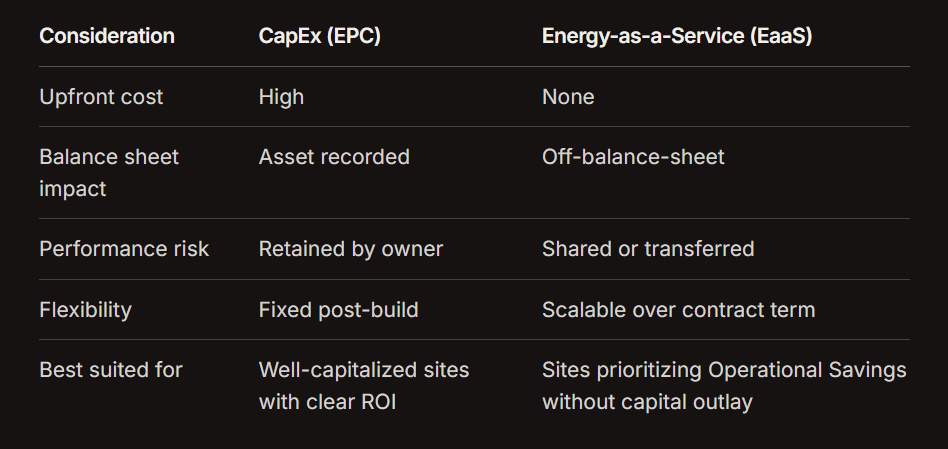
Energy-as-a-Service allows industrial sites to transition away from gas and reduce operating costs without upfront capital expenditure — making projects viable that would otherwise stall in the approval process.
Before any hardware decision is made, a site-wide energy audit is the essential first step. Procurement without a clear picture of load profiles, tariff structure, and Process Heat demand routinely leads to undersized or mismatched systems. And navigating the interaction between solar energy generation, battery dispatch, grid tariffs, and industrial thermal loads requires a trusted advisor — not a product vendor. The right starting point is an honest feasibility assessment, not a panel quote.
Ready to assess what's possible on your site? Request an energy assessment to evaluate the integrated savings opportunity before committing to hardware.

