Why Australian Industrial Leaders Can't Afford to Wait for Heat Pump Electrification
The High Cost of Inaction in the Australian Industrial Gas Market
Australian industrial businesses relying on gas face a compounding financial risk that strengthens the case for industrial heat pump electrification with every passing quarter.
Gas price volatility is not a temporary disruption — it's a structural feature of the Australian market. According to the Australian Competition and Consumer Commission (ACCC) Gas Inquiry, industrial gas spot prices have frequently spiked above $20/GJ, exposing manufacturers, processors and facility operators to cost unpredictability that complicates budgeting and long-term planning.
The 'wait and see' approach carries a real cost. Each year a business delays electrification, it remains exposed to the next price spike — with no ability to hedge through contracted electricity rates, on-site generation or predictable fixed operating costs. Electrified systems, by contrast, draw from a more stable and increasingly competitive electricity market, particularly when paired with Commercial Solar or a Battery Energy Storage System (BESS) to offset peak tariffs.
Electrification is increasingly understood as a financial hedge, not just an efficiency upgrade. Replacing gas-fired Process Heat with an Industrial Heat Pump ensures a more predictable energy cost structure while simultaneously reducing total energy consumption — a combination that builds a defensible Business Case independent of any policy or carbon pricing assumptions. Examining the efficiency fundamentals behind that Business Case is crucial.
Why Industrial Heat Pumps Are the Way of the Future
Industrial heat pumps outperform gas on key commercial metrics — cost, efficiency, and long-term operational stability.
The primary advantage is based on physics. A gas boiler converts fuel into heat through combustion, achieving roughly 85–90% efficiency at best. An industrial heat pump doesn't generate heat — it moves it. By extracting thermal energy from ambient air, water, or waste process streams and upgrading it to usable temperatures, a heat pump delivers far more energy output than it consumes in electricity. This ratio is the Coefficient of Performance (COP), and it's where the heat pump vs gas furnace comparison becomes commercially decisive.
Industrial heat pumps can reduce energy consumption by up to 70% compared to traditional gas boilers, according to the International Energy Agency. A COP of 3.0 or higher — meaning 300%+ effective efficiency — is achievable when waste heat recovery is integrated into the system design. That's not a theoretical figure; it's a practical outcome when Thermal Storage and process integration are engineered correctly.
The most immediate opportunity lies in low-to-medium temperature Process Heat — applications running below 150°C such as food processing, dairy, brewing, and light manufacturing. As the Australian Alliance for Energy Productivity notes, electrifying industrial heat is the "low-hanging fruit" for Australian decarbonization, given that 52% of industrial energy use goes toward heat production. These temperature ranges are well within current industrial heat pump capability, making Heat Electrification a credible near-term business case rather than a distant ambition.
Understanding where policy and grid investment fit into this picture is equally important — and that's where the broader national story becomes relevant.
Bridging the 2030 Gap: Policy and Grid Stability
Global heat pump adoption is falling well short of what climate targets demand — and Australia's industrial sector has a concrete policy window to act on right now.
The European Heat Pump Association has flagged that the EU alone could fall 15 million units short of its 2030 ambition. That shortfall signals a broader pattern: deployment timelines keep slipping while energy costs keep rising. The businesses that move now capture the economics; those that wait absorb the risk.
Australia's policy environment is actively shifting to support electrification at scale. The federal government's Capacity Investment Scheme (CIS) is designed to underwrite 32 GW of new renewable capacity, according to the Australian Department of Climate Change, Energy, the Environment and Water. That investment directly addresses one of the most common objections to Heat Electrification: grid reliability. A cleaner, more stable grid doesn't just reduce Scope 2 emissions — it strengthens the long-term business case for every electrified facility operating an Industrial Heat Pump.
This connection matters for commercial building electrification as much as it does for heavy industry. As renewable generation increases its share of the grid, the carbon intensity of every kilowatt-hour drawn from it falls. Facilities that electrify Process Heat today lock in both the operational savings and the emissions reduction trajectory — without needing to revisit their infrastructure as the grid greens over time.
The practical implication is clear: electrifying now allows your facility to benefit twice — first from the immediate energy cost reduction, and again as the grid's carbon intensity declines through the decade. However, capturing that full benefit typically depends on how well the heat pump system integrates with on-site generation and storage — which is where standalone units often fall short.
System Integration: Beyond the Standalone Unit
An industrial heat pump installed in isolation rarely delivers its full commercial potential — and in many cases, it creates new operational problems without solving the underlying cost ones.
The core issue is timing. An industrial heat pump draws significant electrical load, often during peak grid pricing periods. Without Thermal Storage to buffer that demand, the unit runs when the process needs heat — not when electricity is cheapest. The result is that electric heat pump efficiency gains on paper get eroded by demand charges and off-peak/peak price differentials in practice. That's a fixable problem, but only through system design, not equipment selection alone.
The commercial case strengthens when Commercial Solar, a Battery Energy Storage System (BESS), and an industrial heat pump are integrated as a single system. On-site solar generation offsets the heat pump's electricity draw during daylight hours. A BESS captures excess solar and dispatches it during evening process runs or peak tariff windows. Thermal Storage — whether a hot water buffer tank or a phase-change medium — decouples heat production from heat consumption, allowing the heat pump to run on the cheapest available electrons regardless of when the process demand occurs.
Integrated controls are what make this work at scale. A well-configured energy management system continuously reads electricity spot prices, solar output, battery state of charge, and thermal buffer levels to optimize the dispatch sequence. The outcome is measurable Demand Reduction and compounding Operational Savings across every billing cycle — not a one-time efficiency improvement.
This systems-level thinking is also what determines whether a project stacks up financially. The business case for a standalone heat pump may show a 6–8 year Payback Period. The same heat pump, integrated with solar and storage, can compress that to 3–5 years depending on the site's load profile and tariff structure. That difference is significant enough to change investment decisions — and it's why the next consideration for most industrial operators isn't whether to invest, but how to fund it without tying up capital.
Overcoming the CAPEX Barrier with Energy-as-a-Service
The single biggest obstacle to Australian industrial energy optimization isn't technology — it's the upfront cost of replacing gas infrastructure with electrified systems.
Traditional capital expenditure models require facilities to fund equipment procurement, installation, and commissioning from their own balance sheet. That can mean $500,000 to several million dollars deployed before a single dollar of Operational Savings is realized. For many industrial operators, that capital competes directly with core business investment, which stalls decisions — often for years.
Energy-as-a-Service (EaaS) removes that barrier entirely by converting capital expenditure into a predictable operating cost, with savings starting from day one.
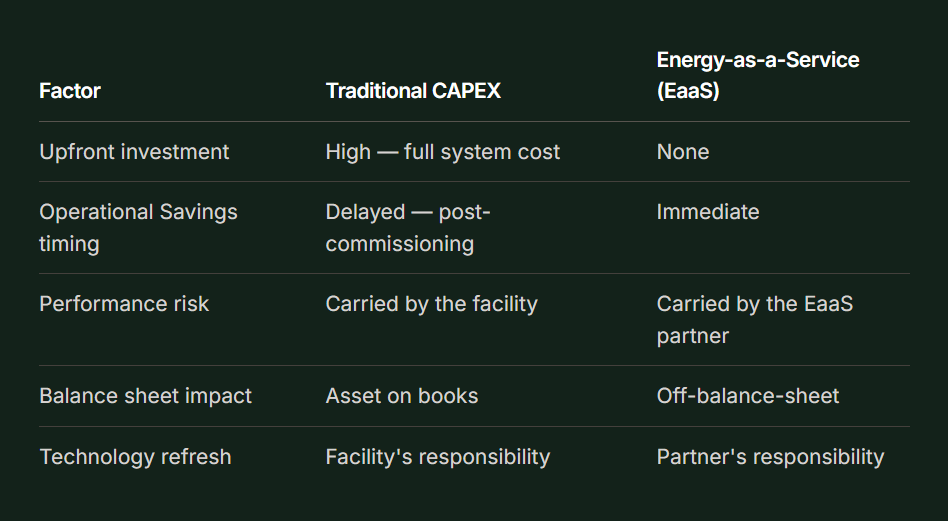
Under an EaaS model, a specialist partner designs, funds, installs, and operates the Industrial Heat Pump system. The facility pays a fixed or variable service fee — typically structured so that the fee is lower than the energy costs it replaces. That means cash flow improves immediately, with no capital at risk.
The risk-transfer dimension is equally important. If the system underperforms, the obligation sits with the operating partner, not the facility. That's a fundamentally different commercial proposition from purchasing equipment outright and absorbing any shortfall internally.
Understanding the EaaS model sets the stage for evaluating the full business case — which depends on how gas prices, electricity tariffs, and system integration combine to determine total return.
The Bottom Line: What You Need to Know
Process heat decarbonization isn't a future planning exercise — it's a financial decision Australian industrial facilities are already being forced to make by rising gas costs, grid volatility, and tightening energy budgets.
The core case is straightforward:
Industrial heat pumps deliver up to 70% energy reduction compared to gas-fired systems— a direct, measurable impact on operational costs that compounds annually as gas prices continue to climb.
Australian gas volatility makes electrification a necessary financial hedge, not an environmental preference. Facilities locked into gas face structural cost exposure that electricity-based systems avoid.
Integrated systems combining Heat Electrification, Commercial Solar, and a Battery Energy Storage System consistently outperform standalone units— the Operational Savings from a coordinated approach are materially higher than any single technology can deliver alone.
Energy-as-a-Service removes the upfront CAPEX barrier, converting what was previously a multi-million-dollar capital decision into a predictable operating expense with a defined Payback Period.
As the IEA confirms, and Bloomberg/IEA data reinforces, industrial electricity demand is on track to double — meaning the economics of electrification only improve as grid infrastructure scales. The facilities that assess their options now will have better technology choices, better financing terms, and lower transition costs than those that wait. The next step is understanding whether your specific facility is ready to act.
Evaluating Your Facility's Electrification Readiness
A site-level audit is the most important first step any Australian industrial facility can take before committing to Heat Electrification. Equipment selection comes second — understanding your existing Process Heat requirements, gas consumption patterns, and electrical capacity comes first.
In practice, facilities that skip the audit stage often oversize or undersize Industrial Heat Pump systems, which directly affects the Payback Period and undermines the Business Case. A structured assessment maps your thermal load profile against available technology, identifies integration points with existing infrastructure, and flags any electrical upgrade requirements before capital is committed.
Industrial Heat Pump technology is now mature enough to deliver process temperatures up to 150°C— covering the majority of heat demands in food processing, dairy, brewing, and light manufacturing, according to the Australian Alliance for Energy Productivity. For facilities operating within this range, electrification is a viable and commercially sound option today, not a future consideration.
Key questions a feasibility assessment should address: What temperature ranges does your process require, and are they within current heat pump capability?, What is your current gas consumption and cost per GJ?, What electrical infrastructure upgrades would be required to support electrification?, and Is Energy-as-a-Service a more appropriate delivery model than outright capital expenditure? Geckon works with Australian industrial facilities to answer these questions through structured feasibility assessments and system design — helping businesses determine whether electrification stacks up before any capital is committed. If your facility is still running on gas for Process Heat, now is the right time to understand your options.

