Why Your 2027 Gas Contract Expiry is a Decarbonization Deadline, Not Just a Renewal
The 2027 Supply Cliff: Why This Renewal Cycle is Different
Industrial gas users approaching contract expiry have historically treated renewal as an administrative task — compare rates, negotiate terms, sign for another two or three years. That straightforward process is no longer available to businesses with contracts expiring around 2027.
East coast gas markets are approaching a structural shortfall, not a temporary price spike. The ACCC's June 2024 Gas Inquiry Interim Report revised the timeline for supply gaps forward by a full year, now projecting shortfalls from 2027. ACCC Commissioner Anna Brakey was direct: "Our current projections indicate the potential for structural gas shortfalls on the east coast from 2027 unless supply increases or demand decreases."
Southern states face compounded exposure. Declining local production in Victoria and South Australia means these markets are increasingly dependent on Queensland LNG-linked supply — at prices set by export parity, not domestic demand. Businesses that treated the last renewal cycle as routine now find themselves facing a fundamentally different market structure.
For industrial users currently weighing whether now is the best time to lock in natural gas rates, the honest answer is that the question itself may be framing the decision too narrowly. Locking in a fixed rate manages price risk in the short term, but it doesn't address what happens when that contract expires into a market with insufficient supply. The sections that follow examine both sides of that decision — starting with the real risks of committing to long-term gas contracts at the top of a supply-constrained market.
The Risk of Locking In: Pros and Cons for Industrial Users
Fixing your gas rate provides cost certainty — but in a supply-constrained market, it can mean locking in at the worst possible moment.
As the previous section outlined, the 2027 renewal cycle is shaped by structural supply pressures that have no clear resolution timeline. That context changes how industrial users should evaluate fixed-rate contracts.
The case for fixing is straightforward. Budget certainty protects operations from immediate price spikes and simplifies financial forecasting — particularly for manufacturers with tight margin profiles. Fixed contracts also reduce procurement management time and offer protection if spot prices surge unexpectedly in the short term.
The risks, however, are harder to dismiss. Many businesses asking "will natural gas prices go up in 2027" are right to be concerned — and locking in now may mean committing to rates that reflect peak supply-crunch conditions rather than a temporary spike. The AEMO 2024 Gas Statement of Opportunities confirms that southern Australian states face a structural supply gap by 2028 as local production declines faster than demand. A three-year fixed contract signed under those conditions offers certainty at the wrong price.
Standard 12–24 month contracts compound this problem. They're too short to bridge the supply gap, but long enough to damage industrial competitiveness if rates are fixed near the peak. What looks like risk management on paper can become a cost liability in practice.
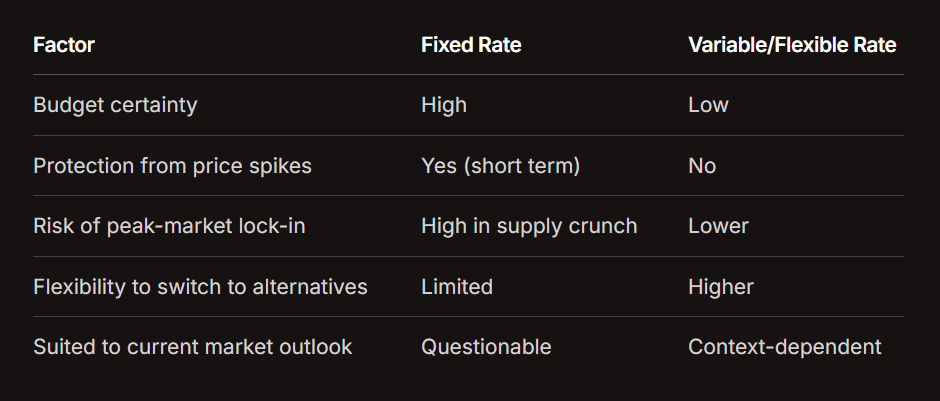
The deeper issue is that neither a fixed nor a variable contract addresses the structural question: whether gas remains the right energy source for your process load at all. That question matters more when evaluating whether the price pressure industrial users face is a cyclical event — or something more permanent.
Will Natural Gas Prices Go Up in 2027?
Gas price pressure in Australia's industrial market is structural — driven by supply decline, underinvestment, and LNG export parity — not a temporary pricing cycle.
For businesses facing industrial gas contract expiry in Australia, the central question isn't whether prices will move, but by how much and for how long. The answer, based on current supply fundamentals, isn't reassuring.
According to the AEMO 2024 Gas Statement of Opportunities, production from southern gas fields is declining faster than demand is falling — a gap that requires new investment to avoid winter shortfalls. That investment hasn't materialized at the scale needed. When supply infrastructure goes uncommitted, the market doesn't wait: prices rise to attract the capital required to fill the gap, and industrial users absorb that cost through higher contract rates at renewal.
Three structural forces are pushing prices higher:
Declining southern field output creates tightening supply precisely where industrial demand is concentrated, amplifying seasonal pressure
Winter shortfall risk in Victoria and South Australia means spot prices spike during peak demand periods, pulling contracted rates upward across the market
LNG export parity pricing sets a floor on domestic gas prices — producers can sell into international markets, so domestic buyers must compete at export-equivalent rates regardless of local demand conditions
The result is a price floor that doesn't fall even when demand softens. This isn't a seasonal phenomenon that resolves after winter or after a single contract cycle. The structural mismatch between declining production and persistent industrial demand means each renewal — including 2027 — carries a higher baseline than the last.
For industrial operators, this changes the calculus significantly. A fixed-rate contract might offer short-term predictability, but it locks in costs against a rising structural floor. Understanding whether that floor can be partially bypassed — through demand reduction or heat electrification — is where the real business case begins. That's exactly what the efficiency economics of industrial heat pumps address next.
The Efficiency Arbitrage: industrial heat pumps vs. Gas
Electrification of industrial heat isn't viable on unit price alone — it wins because efficiency fundamentally changes the cost equation.
Australia's electricity-to-gas price ratio sits at roughly 2:1 on a per-gigajoule basis. On the surface, that looks like a case against switching. But an industrial heat pump doesn't consume one unit of electricity to produce one unit of heat — it moves heat, typically delivering 2.5 to 4.5 units of thermal output for every unit of electricity consumed. That ratio is the Coefficient of Performance (COP), and it's what makes electrification commercially compelling even before gas prices rise further.
The numbers make the case directly. The Institute for Energy Economics and Financial Analysis estimates that industrial heat pumps can reduce energy costs by 36% to 75% compared to conventional gas-based thermal systems. At a COP of 3.5, a site paying twice the unit price for electricity still achieves a lower effective heat cost than gas. As the ACCC's 2024 Gas Inquiry Interim Report projections harden supply concerns, that margin only widens.
Operational longevity reinforces the Business Case. gas boilers carry significant maintenance overhead — burner servicing, flue compliance, pressure vessel inspections — and typical service life runs 15 to 20 years. industrial heat pumps have fewer combustion components, lower servicing frequency, and comparable operational lifespans, reducing total cost of ownership over the asset's life.
The strategic framing matters here: heat electrification isn't just an Operational Savings play — it's a hedge. Locking into gas infrastructure for another decade means accepting full exposure to a structurally constrained market. Electrifying process heat, by contrast, opens access to contracted renewable electricity, on-site Commercial Solar, and off-peak tariff structures. For sites exploring how integrated energy systems can de-risk future energy costs, the efficiency arbitrage is the foundation — but it works best when heat, power, and storage are designed together.
Strategic Integration: Heat, Power, and Storage as One System
Treating electrified heat as a standalone swap — an industrial heat pump vs gas boiler cost comparison, then a purchase order — is the most common planning mistake in industrial decarbonization. The economics only hold when heat, power, and storage are engineered as a single system.
System-level thinking transforms process heat from a utility expense into a managed asset. A heat pump running on grid electricity at peak tariff rates narrows its cost advantage quickly. But connect that same heat pump to rooftop solar generation, buffer its output with thermal storage, and back-fill overnight demand with a Battery Energy Storage System (BESS), and the delivered cost of heat drops to a fraction of gas-fired alternatives.
The three integrated components work together in a defined sequence:
Commercial Solar generates low-cost electricity during daylight hours, providing the primary energy input to the industrial heat pump
Thermal Storage captures that heat and holds it for process demand outside solar generation windows, shifting load away from peak grid tariffs
BESS fills the remaining gaps — overnight, cloudy periods, or demand spikes — ensuring continuous process heat without grid exposure
In practice, each component reinforces the others. Solar reduces the cost of electricity input. Thermal storage decouples generation timing from process demand. BESS provides resilience and further Demand Reduction against peak network charges. Remove any one element and the system's Operational Savings diminish substantially.
This integrated approach is the foundation of a credible business case for heat electrification — and it's the right framework to carry into any decision made before your 2027 gas contract expires.
The Bottom Line: What You Need to Know for 2027
Treating a 2027 gas contract expiry as a routine renewal is one of the most expensive decisions a facility manager can make right now.
The structural case for acting before that deadline is clear:
The supply shortfall is confirmed. Inaction isn't a neutral choice — it means accepting exposure to constrained supply and structurally higher prices as the default outcome.
Rate lock-ins offer short-term budget stability, not long-term protection. Locking in rates buys time, but it doesn't change the underlying trajectory of gas costs. It defers the problem without solving it.
Industrial heat pumps deliver 36–75% cost reductions by replacing combustion efficiency with electrical efficiency — a fundamentally different cost structure, not a marginal improvement.
System integration is the only full solution. Combining Commercial Solar, an industrial heat pump, and a Battery Energy Storage System (BESS) is what truly decouples operational costs from gas price volatility. No single technology achieves that alone.
The 2027 deadline is real, and the facilities that start feasibility work now will have the most options. According to Geckon's operational guidance, assessments should begin at least 18 months before contract expiry to allow for realistic Energy Performance Contract timelines.
The good news is that the capital barrier to this transition is lower than most facility managers assume. energy-as-a-service for industrial heat removes the upfront CAPEX burden entirely — which is where the next section picks up.
Beyond CAPEX: Financing the Transition with energy-as-a-service
The upfront cost of industrial electrification is a real barrier — but it's no longer the deciding factor it once was.
For many facilities, the Business Case for replacing gas-fired equipment stalls at the capital expenditure conversation. industrial heat pumps, Battery Energy Storage Systems (BESS), and integrated controls represent meaningful upfront investment, and not every organization can absorb that on the balance sheet, regardless of the long-term Operational Savings on offer.
energy-as-a-service (EaaS) changes that equation. Rather than purchasing equipment outright, businesses access fully integrated energy systems — including design, installation, monitoring, and maintenance — under a structured service agreement. The cost shifts from CAPEX to OPEX, aligned directly to energy savings delivered. According to Geckon's EaaS framework, industrial sites can transition away from gas while lowering operating costs through integrated system management, without triggering a capital approval process.
The practical difference between the two approaches is significant:
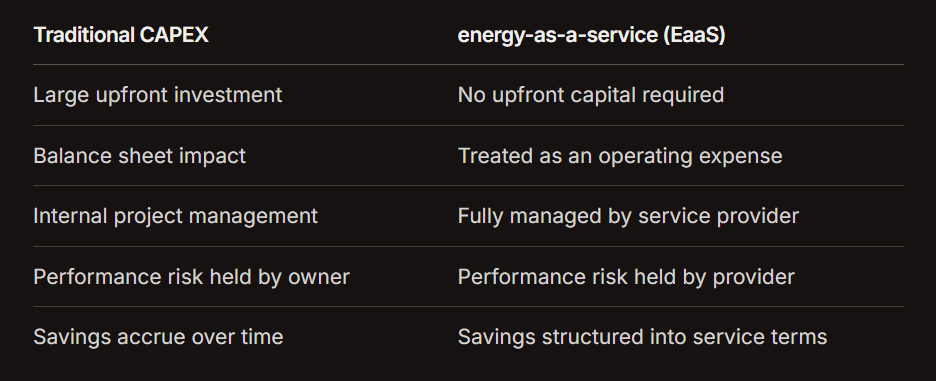
Your 2027 gas contract expiry is the natural trigger point for this conversation. The practical next step isn't a procurement decision — it's a feasibility assessment that maps your facility's energy profile, identifies heat electrification and Demand Reduction opportunities, and models both CAPEX and EaaS pathways side by side. A system-level audit gives you the data needed to make that decision with confidence, not guesswork.
If your gas contract expires in 2027, the time to begin that assessment is now— not at renewal, when options narrow and costs are locked in.

