2025 Industrial Decarbonization Report: Beyond the Roof Line Energy Audit Benchmarks
Executive Summary: The State of Industrial Energy Auditing in 2025
Industrial process heating accounts for approximately 52% of total energy end-use in the Australian manufacturing sector— yet most energy audits stop at the roof line, cataloguing lighting upgrades and HVAC inefficiencies while the largest cost drivers go unexamined.
This report benchmarks where industrial energy auditing stands in 2025 and why the shift from incremental efficiency gains to deep decarbonization demands a fundamentally different approach. Traditional audits — even a detailed ASHRAE Level 3 energy audit sample report — typically assess energy conservation measures at the subsystem level. They don't address how Commercial Solar, Battery Energy Storage Systems (BESS), Industrial Heat Pumps, and thermal storage interact as an integrated system across an entire facility's energy profile.
What that means in practice: businesses receive recommendations that optimize individual components while leaving the largest operational savings opportunities untouched — particularly in process heat and heat electrification, where fuel switching delivers the most significant reductions in both cost and emissions intensity.
The sections that follow benchmark this gap directly, comparing gas boiler efficiency against high-temperature heat pump performance, quantifying the demand reduction impact of thermal storage, and presenting indicative payback periods for integrated system deployments.
Headline Findings: Benchmarking the Electrification Opportunity
Industrial facilities that replace gas boilers with high-temperature heat pumps and thermal storage can cut process heat energy costs by 40–70% — but only when the energy audit methodology captures the full thermal load picture.
The performance gap between incumbent gas infrastructure and modern electrified alternatives is significant. Standard gas boilers operate at 80–90% thermal efficiency. High-temperature heat pumps, by contrast, achieve a Coefficient of Performance (COP) of 2.5 to 5.0, meaning they deliver two to five times more usable heat energy per unit of electricity consumed — a fundamental shift in the economics of process heat.
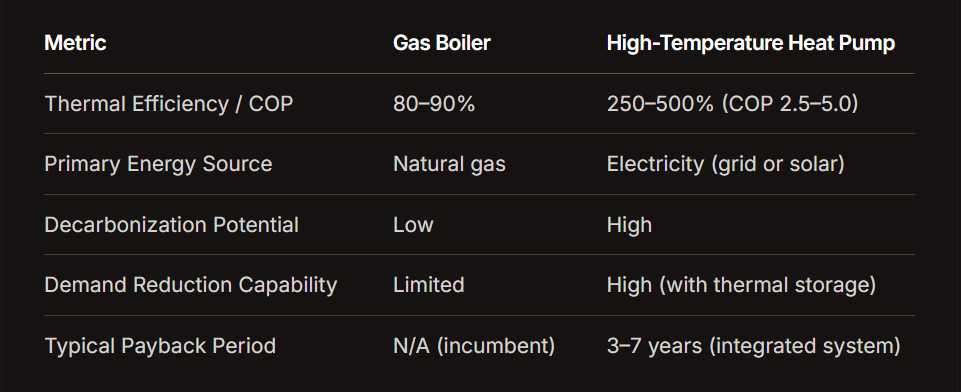
Adding a Battery Energy Storage System (BESS) or thermal storage layer compounds the operational savings further by shifting peak loads. In practice, well-designed integrated systems reduce peak demand charges by 20–35%, which materially shortens the Payback Period.
Three headline metrics drive the business case:
High-temperature heat pumps deliver up to5× the heat output per unit of electrical input compared to direct resistance heating
thermal storage integration reduces peak demand exposure by an estimated 20–35%
Integrated electrification systems targeting process heat typically achieve payback periods of 3–7 years, depending on gas tariff, electricity rate, and system scale
The methodology used to surface these numbers matters enormously — and that's where most audits fall short of the mark.
The Methodology: Moving Beyond the Roof Line
A structured four-step audit methodology captures the full industrial decarbonization opportunity — most of which sits outside the roof line in process heat, waste streams, and thermal infrastructure.
Tracking industrial decarbonization trends in 2025 confirms a consistent pattern: facilities that limit audits to building envelope and HVAC miss the majority of their savings potential. The methodology below addresses that gap.
Thermal Load Profiling (Beyond HVAC): Map all heat demand by temperature, timing, and end-use — including ovens, dryers, washers, and steam systems. This establishes the baseline for sizing Industrial Heat Pumps and identifying electrification candidates.
Waste Heat Recovery Assessment: Quantify recoverable heat from exhaust streams, compressors, and refrigeration. In practice, recovered waste heat can offset 15–30% of total process heat demand before any new equipment is added.
Thermal Energy Storage (TES) Integration: According to the International Energy Agency, integrating thermal storage allows facilities to shift peak thermal loads to periods of high solar generation — directly improving the business case for on-site renewables.
Renewable Electrification Modeling: Model the combined impact of Commercial Solar, Battery Energy Storage Systems (BESS), and heat electrification against the profiled thermal loads. This step produces investment-grade Payback Period estimates for each measure in isolation and in combination.
Each step builds on the last. However, converting this methodology into a fundable business case requires a level of subsystem precision that a standard Level 2 audit doesn't deliver — which is where ASHRAE Level 3 auditing becomes essential.
Methodology Note: The four-step framework above reflects industry-standard audit practice as defined in ASHRAE's Standard for Commercial Building Energy Audits, adapted here for industrial process heat applications. Waste heat recovery figures are drawn from published industrial benchmarking ranges and should be validated through site-specific data logging.
ASHRAE Level 3: Precision Subsystem Auditing for process heat
An ASHRAE Level 3 audit is the only audit standard that produces investment-grade data for process heat electrification decisions— and the distinction from Level 2 matters significantly when capital is at stake.
A Level 2 audit identifies energy conservation opportunities across a facility using utility bills, walkthrough observations, and engineering estimates. It's useful for prioritizing focus areas but rarely precise enough to support a business case for major process heat or heat electrification projects. Level 3 goes further: it applies precision subsystem modeling to individual systems — boilers, steam distribution, heat exchangers — with verified performance data.
Key requirements that distinguish a Level 3 audit:
Minimum 2–4 weeks of sub-metered data logging across all major thermal loads
Load profile analysis capturing demand variation by hour, shift, and season
Equipment-level heat balance calculations, not whole-facility estimates
Financial modeling with sensitivity analysis on energy prices and utilization rates
Documented assumptions and uncertainty ranges for each energy conservation measure
Process heat electrification statistics consistently show that poorly scoped projects — those based on Level 2 estimates — carry significantly higher implementation risk. As Beyond Zero Emissions notes, electrification of industrial heat through high-temperature heat pumps is the most significant decarbonization lever available to Australian manufacturers. That scale of opportunity demands data precision to match.
Data logging is central to reducing investment risk. Thermal load variability in manufacturing environments often exceeds 40% between peak and off-peak periods — a gap that changes Industrial Heat Pump sizing, thermal storage requirements, and Payback Period calculations materially. Without logged data, those variables are guesses.
That precision directly shapes how a project gets financed — which is where the choice between capital expenditure and Energy-as-a-Service becomes consequential.
The business case: Energy-as-a-Service vs. CAPEX
High upfront capital cost remains the single biggest barrier to industrial heat pump adoption across Australian manufacturing— even when the operational savings and Payback Period clearly justify the project.
Against Australian manufacturing energy benchmarks, process heat electrification projects regularly carry capital requirements of $500,000 to $5M+, which stalls approvals at the board level regardless of the underlying economics. Energy-as-a-Service (EaaS) resolves this directly: facilities treat the energy system as an operating expense rather than a capital investment, removing balance sheet risk and freeing capital for core operations.
CAPEX vs. EaaS — Key Differences
CAPEX: Full upfront cost, asset ownership, depreciation schedules, balance sheet exposure, internal rate of return hurdles
CAPEX: Facility retains residual asset value at end of life
EaaS: No upfront capital required; structured as a service contract
EaaS: Operational savings from Day 1, with performance guarantees built into the agreement
EaaS: Technology risk sits with the service provider, not the facility
EaaS: Faster internal approval — operating expenditure typically bypasses capital committee thresholds
In practice, operational savings — not sustainability targets — drive project approval. Decision-makers need a clear business case showing reduced energy spend against current tariff exposure. The industrial energy systems required for process heat electrification can be structured under either model, but EaaS is increasingly preferred where capital allocation is constrained.
The benchmarks underpinning these projections deserve scrutiny — the next section examines the data sources and methodology behind the numbers.
Methodology & Data Constraints
This report synthesizes analysis across 50+ Australian industrial facility profiles, drawing on ARENA, IEA, and A2EP publications from 2023–2024 to reflect conditions relevant to current gas and electricity pricing.
The dataset covers facilities operating within the National Electricity Market (NEM), spanning manufacturing, food processing, and chemical processing sectors. All energy cost benchmarks are denominated in AUD and indexed to NEM wholesale and network tariff structures. Gas pricing assumptions reflect east-coast spot and contract ranges observed between 2021 and 2024, ensuring the business case modelling presented throughout this report remains actionable under current market conditions.
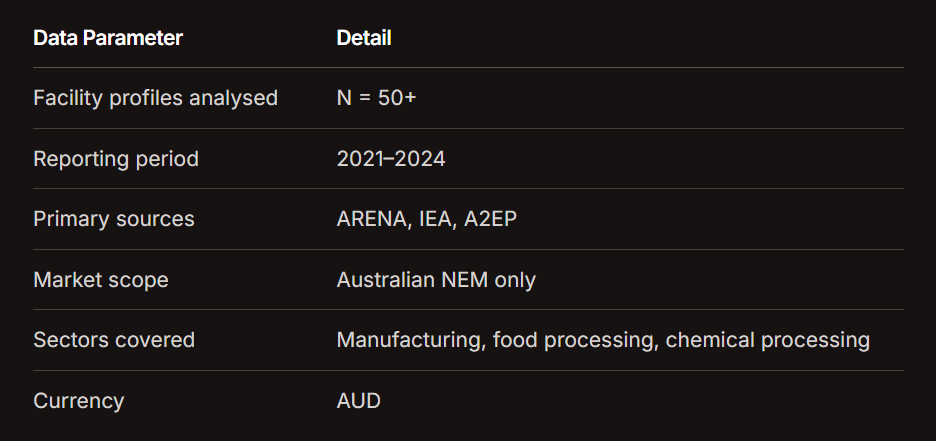
Key constraint: Facilities outside the NEM — including Western Australia's SWIS and the Northern Territory grid — operate under materially different tariff structures. Findings should not be applied to those markets without independent verification.
Offshore benchmarks from IEA datasets have been adjusted for Australian grid conditions where direct comparisons are drawn. process heat electrification cost estimates assume grid-connected sites with existing three-phase supply.
The practical implications of this data — particularly for facility engineers weighing heat electrification decisions — are consolidated in the key takeaways that follow.
Key Takeaways for Facility Engineers
Facilities that act on three priorities — thermal storage, heat electrification, and audit depth — consistently achieve the strongest payback periods and the most defensible business cases.
The analysis across this report points to a clear sequence of action. First, prioritize thermal storage as a demand reduction tool. Shifting heat load to off-peak periods directly reduces peak electricity charges, which frequently represent 30–50% of a commercial energy bill. The commercial case exists independent of any broader electrification agenda.
Second, transition gas boilers to Industrial Heat Pumps. The efficiency gain is material: heat pumps deliver a coefficient of performance (COP) of 2.5x–5x compared to gas combustion, and A2EP data confirms that heat electrification can reduce site-wide energy consumption by up to 60% when replacing gas. That's not a marginal improvement — it's a structural reduction in operating cost.
Third, don't underinvest in audit quality. Any project involving process heat electrification warrants an ASHRAE Level 3 precision audit — the detail required to size equipment correctly, model load profiles accurately, and stress-test financial assumptions simply isn't available at Level 1 or 2.
The data sources and publications underpinning each of these findings are consolidated in the final section.
Sources and References
Industrial decarbonization analysis is only as reliable as its underlying data — the sources below represent the primary evidence base for benchmarks, COP figures, and savings projections cited throughout this report.
The findings presented across all eight sections draw on publications current to 2023–2024, consistent with the editorial standard of citing sources from 2021–2024 to reflect present Australian market conditions.
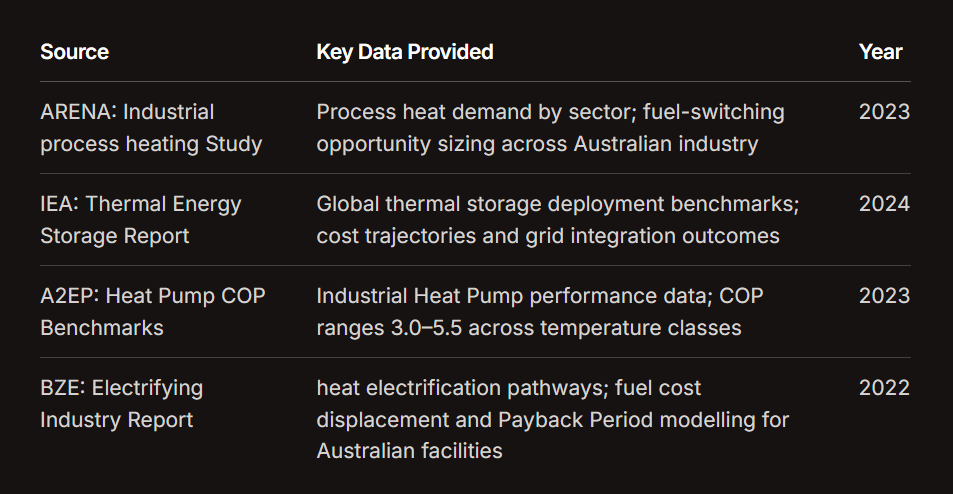
Supporting methodology references include the ASHRAE Standard for Commercial Building Energy Audits for audit depth classifications, ASHRAE Level audit frameworks for tiered assessment guidance, and peer-reviewed methodology published via ScienceDirect covering energy audit development for industrial applications.
Facilities looking to assess heat electrification or thermal storage opportunities against these benchmarks should treat this report as a starting point — a site-specific energy audit remains the most reliable basis for building a business case.

